Galvanized steel coil can develop white or light-gray staining when moisture is trapped between tightly wound layers and the surface cannot dry. The condition is known as wet storage stain, and it is often called white rust in the coated-sheet trade. A light deposit is usually an appearance issue, but prolonged exposure can consume zinc and reduce the protection available to the steel.
For importers, roll-forming factories, roofing-sheet producers, and steel service centers, the practical question is not simply whether a galvanized steel coil has a white mark. Buyers need to determine how the stain formed, how much zinc remains, and whether the coil is still suitable for processing. This guide explains that assessment and provides a prevention checklist for storage and ocean transport.
What Is White Rust on Galvanized Steel Coil?
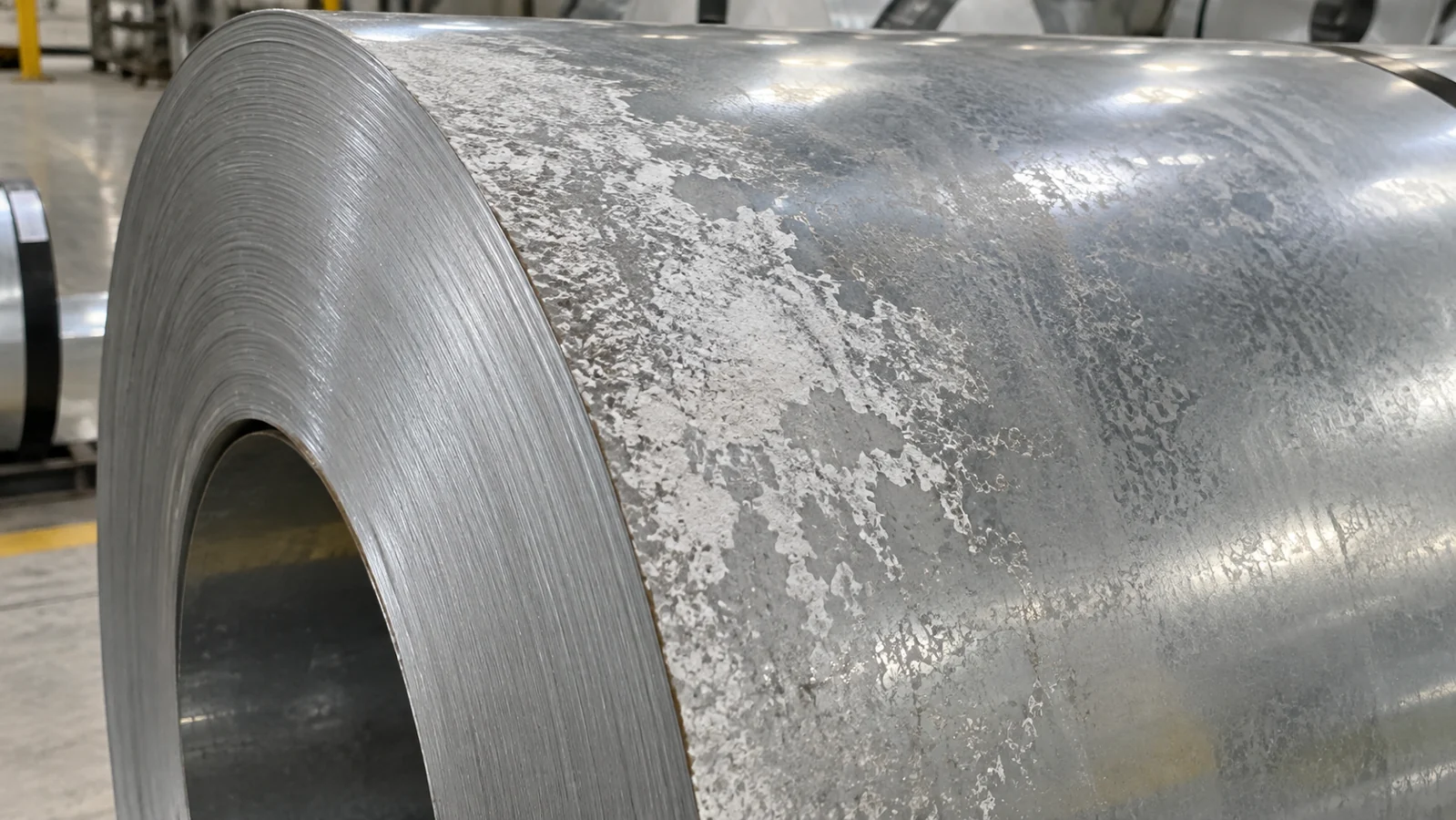
Wet storage stain is a zinc corrosion product that develops when a fresh galvanized surface stays wet without adequate airflow. The deposit is commonly composed of zinc oxide and zinc hydroxide. It may appear powdery, chalky, white, or gray.
The International Zinc Association explains that the condition can occur on galvanized sheet stored while wet in coils, bundles, or stacks. Continuous moisture prevents the surface from forming its normal protective passive film. The American Galvanizers Association likewise notes that rain, dew, condensation, and high humidity can initiate the reaction when adjacent galvanized surfaces restrict ventilation.
This is different from ordinary red rust. Red or brown-red corrosion may indicate that the zinc coating has been severely depleted and the base steel is exposed. White staining begins with the zinc layer itself.
Why Galvanized Steel Normally Resists Corrosion
A galvanized steel coil made by the hot-dip process is protected by a zinc coating. Zinc provides a barrier between the atmosphere and the steel and can also offer sacrificial protection at small scratches and cut edges.
In normal outdoor exposure, fresh zinc reacts with oxygen, moisture, and carbon dioxide. These wet-and-dry cycles gradually form a compact zinc carbonate patina. According to the American Galvanizers Association, this mature patina is stable and water-insoluble, and it slows further atmospheric corrosion.
Wet storage stain interrupts this sequence. Water trapped between coil wraps or closely stacked sheets receives limited oxygen and cannot evaporate. Instead of forming a stable patina, the surface produces a bulky, porous corrosion deposit.
Seven Conditions That Increase the Risk of Wet Storage Stain
1. Condensation Inside Export Packaging
A GI coil may leave a warm factory and enter a cooler container, port warehouse, or vessel hold. If the steel temperature falls below the local dew point, moisture can condense on the coil or inside the wrapping. A waterproof package can keep rain out, but it can also retain condensation when moisture is already inside.
2. Rain or Seawater During Loading
Even brief exposure can allow water to enter through damaged wrapping, coil edges, or the bore. Chloride-contaminated moisture is more conductive than clean water and can accelerate zinc attack. A wet coil should not be sealed until it has been inspected and fully dried.
3. Tight Coil Winding and Restricted Airflow
Closely wound layers are essential to coil stability, but any water drawn between the laps has little opportunity to escape. The same issue affects tightly bundled galvanized steel sheet and nested roll-formed panels.
4. Long Storage in a Humid Warehouse
Coils stored near open doors, damp floors, roof leaks, or major temperature swings are more exposed to condensation. Raising the load from the floor and monitoring temperature and relative humidity reduces this risk.
5. Damaged or Incomplete Packaging
Torn waterproof film, open coil ends, missing edge protection, and loose steel straps provide entry points for moisture. Packaging should be checked at the mill, port, and receiving warehouse rather than only after the final delivery.
6. Missing or Unsuitable Surface Protection
Chromate-free passivation, oiling, or another agreed surface treatment can reduce the risk of storage stain. The correct choice depends on downstream use. For example, excessive oil or an incompatible passivation system may interfere with painting, adhesive bonding, or further coating, so it must be specified before production.
7. Delayed Action After Moisture Is Found
The reaction continues while water remains trapped. Separating, ventilating, and drying affected material promptly can prevent a light surface condition from becoming a coating-loss problem.
How to Grade the Severity Before Accepting or Rejecting a Coil
Appearance alone does not reveal how much zinc has been consumed. White zinc corrosion products can occupy several times the volume of the original zinc, so a dramatic-looking deposit may represent limited metal loss. A practical inspection combines visual evidence, the affected area, and zinc-coating measurements.
| Observed condition | Likely significance | Recommended action |
|---|---|---|
| Thin white haze or light powder; bright zinc remains visible | Usually superficial if exposure was brief | Dry immediately, provide airflow, document the area, and monitor after cleaning or weathering |
| Heavier white or gray deposit across several wraps | Possible measurable zinc loss | Quarantine the coil, clean a test area, and measure coating mass or thickness |
| Dark gray or black areas, pitting, or red corrosion | Potential severe coating consumption or exposed steel | Stop processing and obtain a technical disposition from the supplier and qualified inspector |
For a Z275 galvanized coil or another specified coating designation, the receiving decision should be based on the applicable purchase standard, mill certificate, sampling plan, and measured remaining coating—not on color alone. The same principle applies to an ASTM A653 galvanized sheet order or an EN 10346 galvanized coil order. The standard named on the purchase contract determines the formal acceptance criteria.
Does Light White Rust Shorten Service Life?
Light wet storage stain does not automatically mean that a galvanized steel coil has lost its intended corrosion performance. Both the International Zinc Association and the American Galvanizers Association explain that light cases may involve limited zinc loss. Once the surface dries and receives free airflow, the normal zinc patina can continue to develop.
Heavy or prolonged staining is different. It can remove enough zinc to affect the remaining protective life. If the material will be painted, roll formed, bonded, or used as a substrate for color coating, even a superficial deposit may affect appearance or downstream surface preparation. Buyers should therefore evaluate both corrosion protection and process compatibility.
How to Prevent White Rust During Export and Storage
Keep the Coil Dry Before Wrapping
Do not package steel that is wet from rain, quenching, cleaning, or condensation. The coil surface and packaging materials must be dry before the moisture barrier is closed.
Use a Layered Export Package
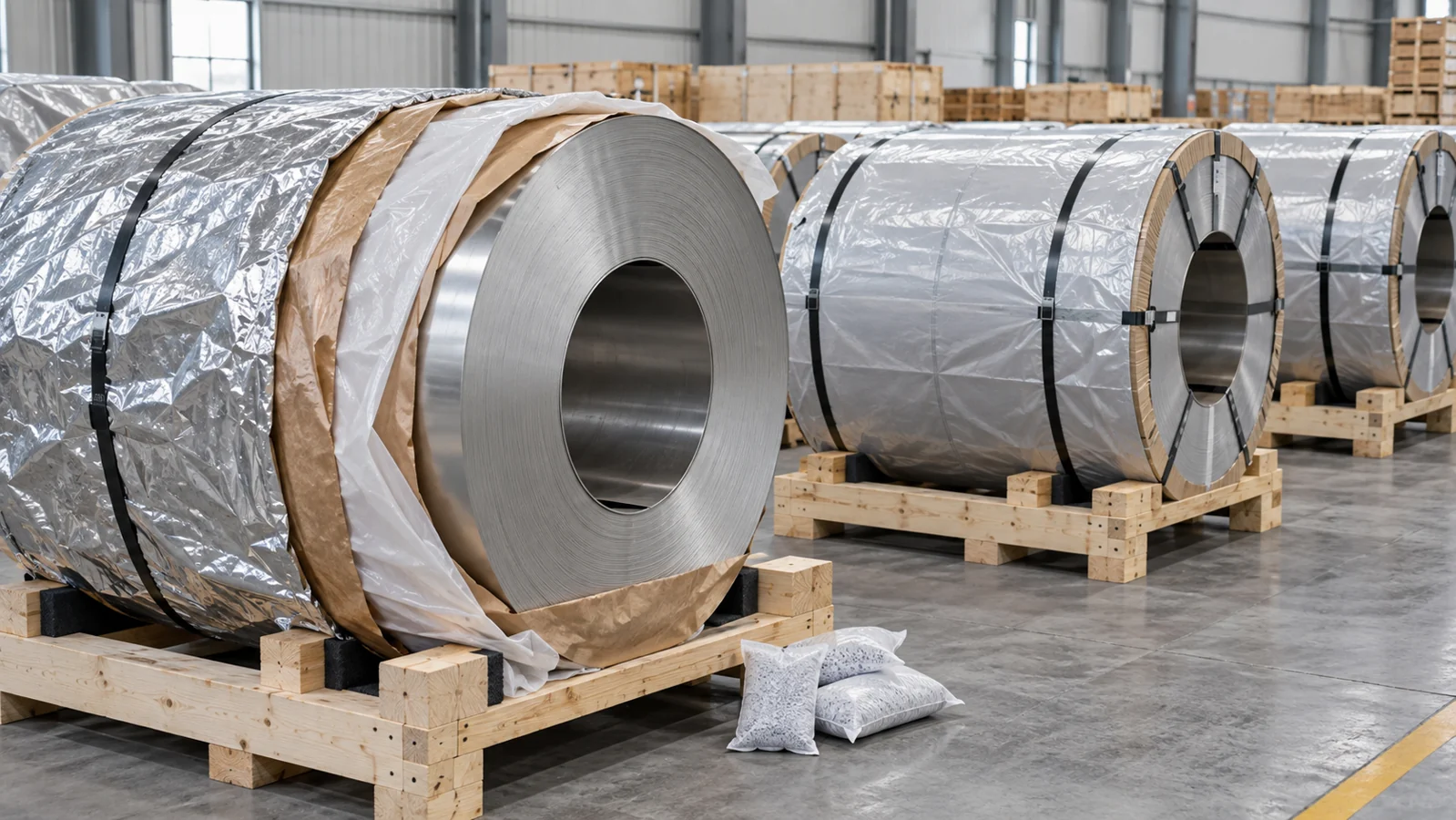
A seaworthy package normally combines an inner moisture barrier, protected inner and outer diameters, edge guards, a rigid outer shell, and secure radial and circumferential strapping. Desiccant can reduce humidity inside a properly sealed package, but it cannot compensate for standing water or a large leak.
Control Container Moisture
Inspect containers for holes, wet flooring, damaged door seals, and residual salt or chemicals. Use suitable dry dunnage and keep packages away from surfaces where water can collect. Container desiccants should be sized for route duration and climate exposure.
Avoid Temperature Shock
When cold coils enter a warm, humid warehouse, condensation can form immediately. Keep the package closed until the coil temperature approaches the indoor environment, unless there is evidence that water has already entered and urgent drying is necessary.
Store Off the Floor in a Ventilated Area
Use engineered coil cradles or supports, maintain clear drainage, and keep coils away from open doors and roof leaks. Any storage method must also follow local coil-handling and load-restraint safety requirements.
Receiving Inspection Checklist for GI Coil Buyers
- Record the condition before unloading. Photograph the container, seals, package exterior, water marks, and any torn wrapping.
- Check identification. Match coil number, grade, coating designation, dimensions, and net weight to the packing list and mill test certificate.
- Inspect moisture indicators. Look for wet timber, condensation, water inside the bore, staining around edge protectors, and corrosion on steel straps.
- Open suspect packages promptly. Do not leave a visibly wet package sealed while a claim is being discussed.
- Inspect several locations. Check the outside wrap, coil edge, bore, and—where safe and authorized—a representative section after controlled uncoiling.
- Measure rather than guess. Compare zinc coating measurements with the purchase specification and record the instrument, calibration, and test locations.
- Segregate affected material. Keep suspect coils dry and separate until a written disposition is agreed.
How to Treat Wet Storage Stain
When a galvanized steel coil shows wet storage stain, the first action is to stop the moisture exposure. Move the material to a dry, ventilated area and allow the affected surfaces to dry.
Light deposits may weather naturally when the product can remain dry and receive airflow. Where cleaning is necessary, the American Galvanizers Association recommends a stiff nylon-bristle brush rather than a wire brush. More persistent deposits may require an appropriate cleaning solution, followed by a thorough fresh-water rinse and complete drying.
Cleaning should begin with a small test area because surface treatments and downstream requirements vary. After medium or heavy staining, measure the remaining zinc coating. Darkened areas, red rust, or significant coating loss require a qualified technical review; they should not be concealed with paint or oil before the cause and remaining protection are documented.
What Buyers Should Include in a Galvanized Coil Order
When ordering galvanized steel coil, a complete purchase specification reduces disputes and helps the mill select the correct process route. Include:
- product standard and steel grade, such as ASTM A653 or EN 10346;
- zinc coating designation, including whether it is total both sides;
- thickness, width, coil ID, maximum OD, and coil weight;
- surface finish such as zero spangle, minimized spangle, or regular spangle;
- passivation, oiling, or chromate-free treatment requirements;
- intended use, including roofing, ductwork, forming, painting, or galvanized coil for color coating;
- export packaging, edge protection, moisture barrier, and container-desiccant requirements;
- inspection method, claim window, and evidence required for transit damage.
Frequently Asked Questions
Is white rust a manufacturing defect in galvanized steel coil?
White rust on galvanized steel coil is not necessarily a manufacturing defect. Wet storage stain usually forms after galvanizing when moisture remains on the zinc surface without enough airflow. The investigation should review mill packaging, loading conditions, transit, and warehouse storage before assigning responsibility.
Can a GI coil with light white rust still be used?
Often yes, but suitability depends on the remaining zinc coating and the downstream process. Dry the coil, document the condition, inspect representative areas, and verify coating thickness before production.
Should white rust be cleaned with a wire brush?
No. A wire brush can damage the zinc surface. Authoritative galvanizing guidance recommends a stiff nylon-bristle brush and, when necessary, a compatible cleaning solution followed by rinsing and drying.
Does heavier zinc coating prevent wet storage stain?
A heavier coating provides more zinc reserve, but it does not prevent trapped-moisture corrosion. Z120 and Z275 galvanized coil both require dry packaging, controlled transport, and ventilated storage.
How can buyers prevent condensation after delivery?
Avoid opening a cold package immediately in warm, humid air. Let the coil temperature equalize in a dry indoor area, unless the package is already wet or damaged and must be opened for urgent drying.
What information should be sent to a galvanized coil supplier when reporting a claim?
Send the coil number, contract specification, mill certificate, container and seal numbers, unloading photographs, package condition, storage timeline, affected locations, and coating measurements. Clear evidence helps the supplier distinguish light surface staining from substantial coating loss.
Conclusion
White rust on galvanized steel coil is best controlled before it starts. Dry material, compatible surface treatment, moisture-resistant packaging, sound container preparation, and disciplined receiving inspection protect both the zinc coating and the buyer’s production schedule.
Cybertron Metal supplies galvanized steel coil for roofing, ductwork, fabrication, and further coating applications. When requesting a quotation, provide the target standard, grade, zinc coating, thickness, width, surface treatment, and destination so the production and packaging plan can be matched to the application.
Contact: jenny@sbtgi.com | WhatsApp/WeChat: +86 13905436749