ASTM A755 coated steel coil is a prepainted, hot-dip metallic-coated steel product intended for exterior building applications. The current active edition is ASTM A755/A755M-18(2024). For buyers, stating “ASTM A755” on a purchase order is only the starting point. The order must also define the substrate, metallic coating, paint system, dimensions, mechanical properties, color, finish and acceptance tests.
This guide explains seven checks that help purchasing teams compare quotations, review mill certificates and avoid specifications that look complete but leave critical performance variables open.
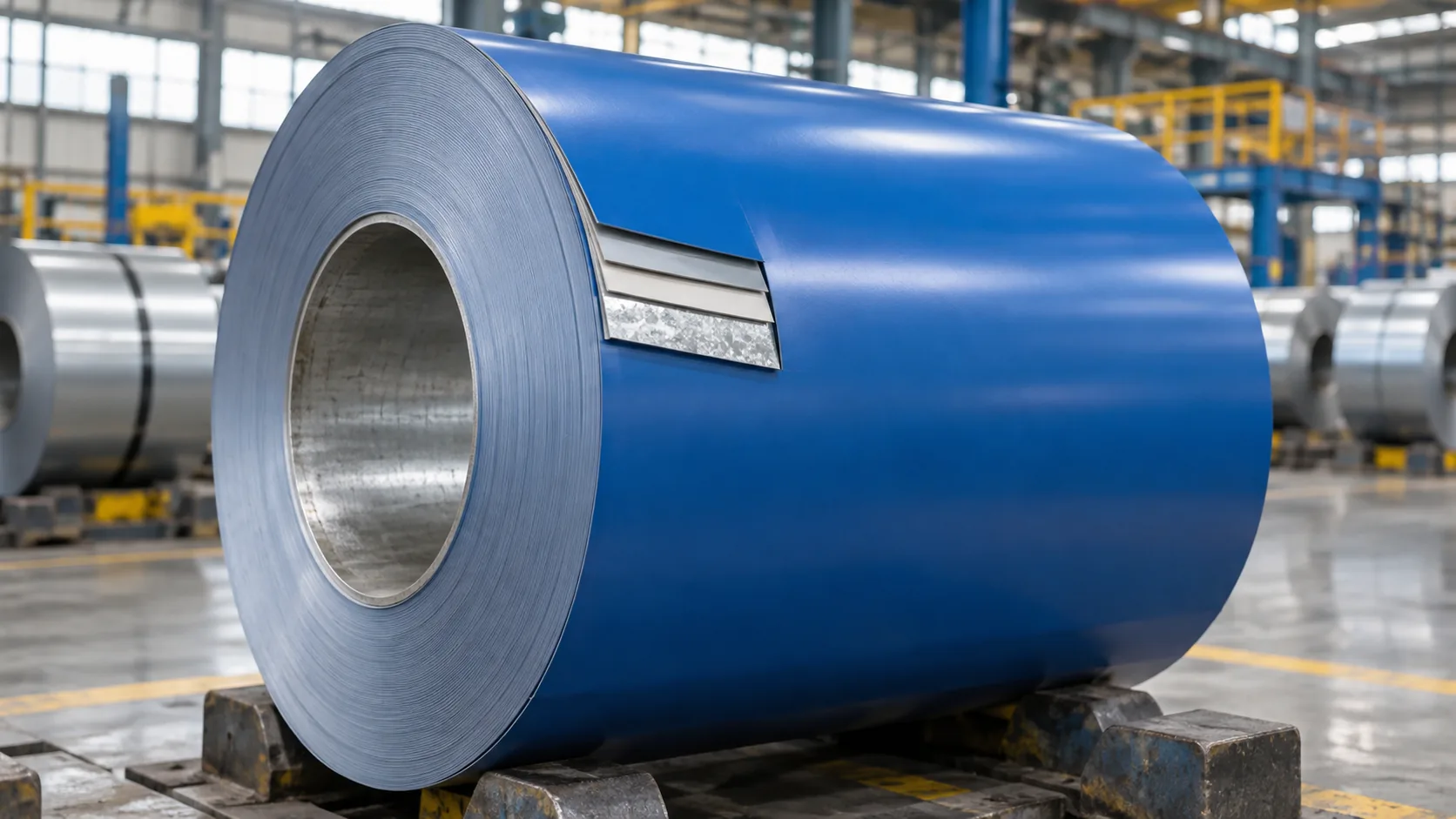
Quick answer: ASTM A755/A755M covers hot-dip metallic-coated steel sheet that is coil-coated with organic films for exterior exposed building products. It may be supplied as coils, cut lengths or formed cut lengths. The standard does not create one universal PPGI grade. The purchaser still needs to select the appropriate steel substrate, metallic coating designation and organic coating system for the intended environment.
What Does ASTM A755 Coated Steel Coil Cover?
ASTM A755/A755M applies to steel sheet that first receives a hot-dip metallic coating and then an organic coil coating. Typical finished products include roofing panels, wall cladding, corrugated sheet and roll-formed or brake-formed exterior building components.
The standard recognizes several metallic-coated substrates. Depending on the purchase specification, these can include zinc-coated steel, aluminum-zinc alloy-coated steel and aluminum-coated steel. The organic coating system normally contains a primer and a topcoat. ASTM identifies common coating chemistries such as polyester, silicone-modified polyester, acrylic, fluoropolymer, plastisol and polyurethane.
This scope matters because ASTM A755 coated steel coil is not the same as any painted steel coil. A product intended only for interior appliances, for example, may use a different substrate, paint system and qualification route. The end-use environment must be clear before a buyer selects the coating system. A complete ASTM A755 coated steel coil order converts that environment into measurable material requirements.
ASTM A755 Coated Steel Coil: 7 Buyer Checks
1. Confirm the Current Standard Edition and Unit System
The active edition listed by ASTM International is ASTM A755/A755M-18(2024). The “A755” designation uses inch-pound units, while “A755M” uses SI units. ASTM states that the two systems are not necessarily exact equivalents and should be used independently.
A clear order therefore identifies the edition and the unit system. A practical line is: “Material shall comply with ASTM A755/A755M-18(2024), SI units.” This prevents a quotation from silently mixing tolerances, thicknesses or test values from different unit systems.
2. Specify the Steel Grade and Metallic-Coated Substrate
The organic paint is only one part of the protection system. Beneath it, the base steel and metallic coating influence strength, formability, cut-edge behavior and corrosion resistance. Buyers should state the required structural or forming grade, nominal steel thickness and the relevant metallic coating specification for the ASTM A755 coated steel coil.
For zinc-coated substrate, the related material standard is commonly ASTM A653/A653M. For 55% aluminum-zinc alloy-coated sheet, ASTM A792/A792M is commonly referenced. General requirements for hot-dip metallic-coated sheet are addressed by ASTM A924/A924M. The correct combination depends on the project and must be confirmed in the contract documents.
Do not use “PPGI” as a substitute for a substrate specification. PPGI describes prepainted galvanized steel in trade language, but it does not identify yield strength, elongation, coating mass or dimensional tolerances.
3. Define Metallic Coating Designation Separately from Paint Thickness
Metallic coating mass and organic paint thickness are different properties. Zinc coating designations such as G90 or their metric equivalents describe the hot-dip metallic layer. Dry film thickness describes the primer and paint film applied during coil coating. One cannot replace the other.
A quotation that says only “20 microns coating” is ambiguous. It should state whether the value refers to the exposed-side paint film, total organic system, back coat or another layer. It should also state the metallic coating designation separately.
For more background on zinc-coated substrate selection, see our galvanized steel coil guide. Buyers who understand both layers can compare offers on equal technical terms instead of comparing one incomplete thickness number.
4. Match the Organic Coating System to the Exposure
ASTM A755 allows several paint chemistries because no single system is best for every building. Standard polyester can be suitable for many general applications. Silicone-modified polyester or high-durability polyester may offer improved weathering for demanding projects. Fluoropolymer systems are often selected when long-term color and gloss retention are especially important.
Paint chemistry alone still does not determine service life. Primer, pretreatment, topcoat thickness, cure, pigment, metallic substrate, forming severity, building design and local exposure all influence performance. Coastal salt, industrial pollutants, ultraviolet radiation, humidity and standing water should be evaluated before the coating system is approved.
When comparing PPGI coil options, ask the supplier to identify the full coating system, not only the topcoat family. A technically useful declaration lists exposed-side primer, exposed-side topcoat, reverse-side coating and their nominal dry film thicknesses.
5. Set Measurable Appearance and Forming Requirements
Exterior panels must remain visually consistent after profiling and installation. The purchase specification should therefore define color reference, permissible color difference, gloss range, surface texture and any protective film requirement. If adjacent panels will be installed on the same elevation, batch control and panel orientation should also be discussed.
Forming requirements are equally important. Roofing and cladding producers bend, roll-form and sometimes stamp the coil. Excessive coating cracking, pick-off or adhesion loss at bends can expose the substrate. The European Coil Coating Association lists EN 13523 methods for color difference, gloss, pencil hardness, impact resistance, adhesion after indentation and T-bend resistance. These methods provide useful language for supplementary acceptance criteria when agreed by buyer and supplier.
Before issuing the order, give the mill representative forming details such as minimum bend radius, roll-forming speed, profile depth and whether the finished sheet will be seamed. A laboratory pass on flat sheet is not a substitute for proving the material in the intended forming process.
6. Agree on Sampling, Inspection and Certificate Content
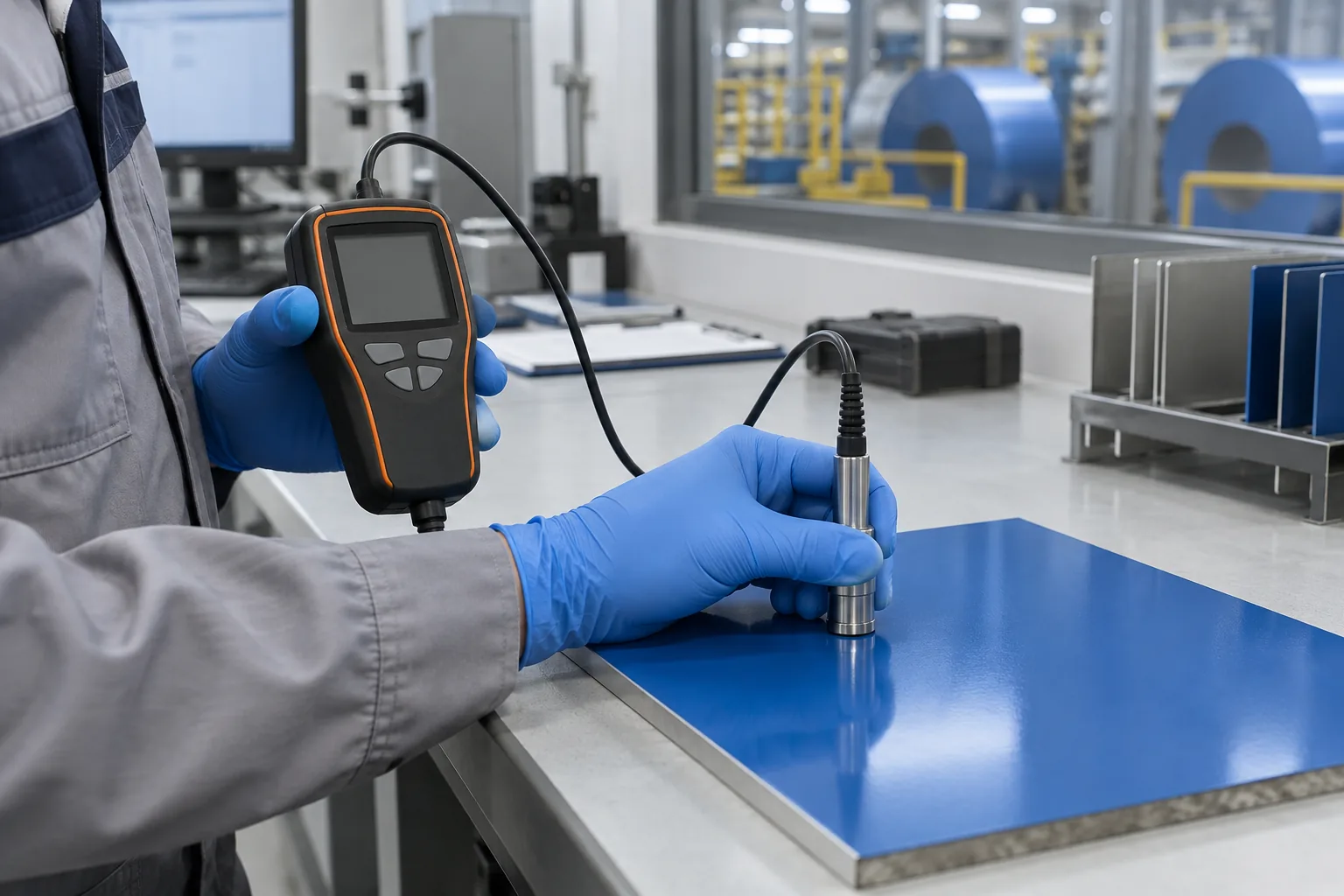
A strong ASTM A755 coated steel coil specification explains how conformance will be demonstrated. State the inspection lot, sampling position, test frequency and certificate type. For coating thickness, measurements should cover representative positions across the strip width rather than one convenient point.
EN 13523-1 describes determination of organic coating thickness on a metallic substrate using electrical measuring devices. Whatever method is selected, the gauge should be suitable for the substrate and calibrated against appropriate standards. A buyer should also distinguish individual readings from the reported average and minimum.
Ask the supplier’s certificate to show at least the order number, coil identification, grade, dimensions, metallic coating designation, paint system, color, coating thickness and agreed test results. Traceability should connect every delivered coil to the reported data.
7. Protect the Coil During Packing, Storage and Installation
Conforming material can still fail prematurely if water becomes trapped in a coil or sheet stack. Specify export packing, edge protection, desiccant where appropriate and transport conditions. On arrival, inspect packaging damage and store coils in a dry, ventilated area with protection from condensation.
During installation, remove metal swarf, prevent contact with incompatible metals and avoid damaging the paint at fasteners and cut edges. Standing water and wet stack storage can cause staining or white corrosion products on exposed galvanized areas. Our guide to white rust on galvanized steel coil explains the main storage risks and prevention steps.
ASTM A755 Purchase Specification Checklist
The following table can be used as a quotation comparison sheet. Project engineers should replace each example with the value required by the building design and local environment.
| Order item | What the buyer should state | Why it matters |
|---|---|---|
| Standard | ASTM A755/A755M edition and unit system | Controls the contractual reference |
| Base steel | Grade, yield strength, formability and thickness | Affects structural capacity and forming |
| Metallic coating | Type, governing standard and designation | Provides sacrificial or barrier corrosion protection |
| Organic coating | Pretreatment, primer, topcoat chemistry and backer | Defines the complete paint system |
| Film thickness | Exposed and reverse sides, nominal and minimum values | Prevents ambiguous “total coating” claims |
| Appearance | Color reference, gloss, texture and tolerances | Supports consistent installed appearance |
| Performance tests | T-bend, adhesion, impact, hardness and durability tests as required | Checks fitness for forming and exposure |
| Dimensions | Thickness, width, coil ID, coil weight and tolerances | Supports production and equipment compatibility |
| Documentation | Certificate fields, sampling plan and traceability | Makes acceptance auditable |
| Packing | Orientation, wrapping, edge protection and labels | Reduces handling and moisture damage |
How to Verify ASTM A755 Coated Steel Coil on Receipt
- Match identities. Compare coil labels, packing lists and certificates against the purchase order.
- Inspect packaging. Record impact damage, wet wrapping, broken seals and telescoped coils before unloading.
- Check dimensions. Verify thickness and width using calibrated instruments and the agreed sampling plan.
- Measure the coating system. Confirm metallic coating documentation and measure organic film thickness with a suitable calibrated gauge.
- Compare color and gloss. Use agreed references, lighting conditions and instruments where specified.
- Run forming tests. Evaluate adhesion and cracking after the bend or profile operation that represents production.
- Quarantine nonconforming coils. Preserve samples, photographs and traceability before processing disputed material.
These controls are most effective when the acceptance criteria are agreed before production. A certificate cannot resolve an ASTM A755 coated steel coil purchase order that never defined the required coating designation or paint system.
Common ASTM A755 Ordering Mistakes
- Specifying only the standard number. ASTM A755 offers choices that the purchaser must complete.
- Confusing zinc coating mass with paint film thickness. Both must be stated and verified separately.
- Selecting paint by price alone. Exposure and forming needs should determine the coating system.
- Ignoring the reverse side. Back coat requirements matter when condensation or insulation contact is possible.
- Using a color name without a reference. State an agreed RAL, sample or instrumental target and tolerance.
- Accepting a generic certificate. Test data must be traceable to the delivered coil.
For a broader overview of grades, dimensions and coating choices, review our color coated steel coil specifications article.
Frequently Asked Questions
Is ASTM A755 the same as ASTM A653?
No. ASTM A755/A755M covers metallic-coated steel sheet that is also prepainted by the coil-coating process for exterior building products. ASTM A653/A653M covers zinc-coated or zinc-iron alloy-coated steel sheet. A prepainted product may use an ASTM A653 substrate, but the two standards address different product scopes.
What is the current ASTM A755 version?
ASTM International lists ASTM A755/A755M-18(2024) as the active edition. Buyers should verify the current listing when a new contract is issued because standards can be revised or reapproved.
Does ASTM A755 specify one paint thickness?
No single film thickness is suitable for every permitted coating system and exposure. The buyer and supplier must agree on the paint system and the exposed-side and reverse-side thickness requirements.
Can ASTM A755 coated steel coil be used for roofing?
Yes. Exterior roofing and cladding are central applications, provided the selected substrate, coating system, mechanical properties and formed profile satisfy the project requirements.
What documents should accompany the shipment?
Request a traceable certificate showing coil identification, grade, dimensions, metallic coating designation, paint system, color, organic coating thickness and all agreed test results. Packing lists and coil labels should use the same identification.
Source-Backed Specification, Project-Specific Selection
ASTM A755 gives buyers a recognized framework for prepainted metallic-coated steel used in exterior buildings. Reliable procurement comes from completing that framework with project-specific values and measurable acceptance criteria. Before ordering, confirm the latest standard edition, local code requirements and the exact contractual clauses with your engineering team.
Need a quotation for ASTM A755 coated steel coil? Send us the substrate standard, steel grade, metallic coating designation, dimensions, paint system, color, annual quantity and destination. Our team can review the specification and prepare a traceable supply proposal.
Technical references: ASTM A755/A755M-18(2024); ECCA overview of EN 13523 coil-coated metal test methods.