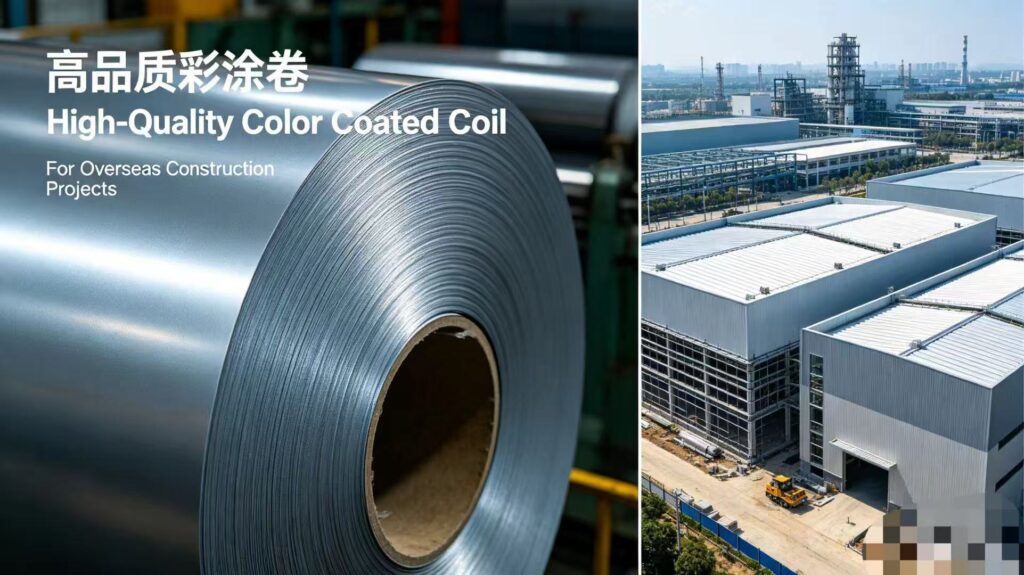
In global steel building material trading, high-quality color coated coil has always been the mainstream material for industrial roofing, wall cladding, warehouse enclosures, and low-rise steel structure buildings.
Many overseas buyers often face quality differences after purchasing ordinary steel materials instead of High-quality color coated coil, such as unstable colors, short service life, and anti-corrosion failures, and anti-corrosion failures after purchasing ordinary steel materials. To help international purchasers select qualified building steel materials efficiently, this article sorts out 9 core evaluation standards for purchasing high-quality color coated coil, covering substrate, zinc layer, paint performance, processing quality and engineering applicability.
Following these rules can effectively avoid inferior products and ensure long-term stable use of color coated coil in outdoor engineering environments.
Uniform Substrate Thickness Guarantees Structural Stability
The galvanized steel substrate is the core foundation of finished High-quality color coated coil. The overall flatness, bending resistance and wind pressure resistance of steel plates all depend on the base material quality.
High-quality industrial-grade color coated coil adopts continuous hot-dip galvanized steel coil as raw material, with strictly controlled thickness tolerance.
The uniform base thickness is the basic guarantee for long-term stable use of High-quality color coated coil in large-span factory roofs and high-wall cladding projects. For large-span factory roofs and high-wall cladding projects, even subtle thickness errors will cause uneven stress, resulting in water accumulation and local paint cracking. Standard substrate thickness is the first basic standard for qualified color coated coil.
Reasonable Zinc Layer Weight Improves Anti-Rust Performance
Different zinc coating grades adapt to different regional climates
Zinc layer weight directly determines the anti-corrosion service life of color coated coil. The zinc layer forms a sacrificial protection layer to isolate air and moisture from eroding the steel base.
Common commercial grade products adopt 60g-80g zinc coating, suitable for indoor decoration and dry inland areas. Engineering-grade color coated coil uses 100g-180g high zinc coating, which can resist humid weather, industrial pollution and mild salt fog erosion.
For coastal countries and high-humidity tropical regions, high-zinc configuration is essential to prevent bottom rust and paint peeling within 10 years.
When evaluating High-quality color coated coil, you must also test paint adhesion, weather resistance and UV resistance to adapt to different regional climates overseas.
To learn more about global anti-corrosion steel standards for construction, you can refer to the technical guide released by World Steel Association.
Different regional climate standards define the weather resistance requirements of building steel coils, as stated in the international construction material specification document.
Classified Paint Materials Determine Outdoor Service Life
PE, HDP and PVDF three mainstream coating systems comparison
The surface organic coating is the most valuable functional layer of color coated coil. Different paint formulas bring completely different weather resistance, UV resistance and color retention effects.
PE polyester coating is cost-effective for temporary buildings with a service life of 3–5 years. HDP high weather-resistant coating enhances anti-fading ability, suitable for conventional outdoor construction with 8–12 years stable performance.
PVDF fluorocarbon coating is the high-end configuration for landmark buildings and coastal projects, achieving more than 20 years of non-fading and non-peeling performance. Buyers can select matching paint grades according to project cycle and local climate.
Standard Coating Thickness Prevents Early Paint Falling
Front and back double-layer coating thickness standard
Qualified color coated coil implements unified primer and topcoat thickness standards in industrial production. The primer guarantees adhesion between steel base and paint layer, while the topcoat undertakes outdoor anti-aging protection.
Regular specifications control primer thickness at 5–10μm and topcoat thickness at 18–28μm. The balanced double-layer structure forms a dense protective film to resist wind sand friction, rainwater scouring and temperature difference expansion.
Low-quality products reduce paint thickness to cut costs, causing thin and uneven coating, which is prone to scratches and peeling during processing and installation.
Strict Batch Color Difference Control Ensures Project Aesthetics
RAL color card unified color matching standard
Large-area building projects require consistent color presentation of the whole roof and wall. Premium color coated coil strictly follows international RAL color standards for batch production.
Professional manufacturers use spectrophotometers to detect color difference of each batch of products, controlling visual error within undetectable range.
Whether it is conventional sky blue, ivory white, gray or customized special colors, the overall laying effect is uniform and beautiful. Inferior color coated coil has unstable color matching formulas, resulting in patchy color difference after laying and serious fading after sun exposure.
Flat Surface Finishing Reduces Later Maintenance Cost
No bubble, no scratch, no roller mark production standard
High-quality color coated coil features smooth surface, uniform paint flow, neat cutting edge and no burrs. Advanced fully automatic coating production lines eliminate manual defects and dust pollution.
A perfect surface not only improves the overall grade of building engineering but also has excellent self-cleaning performance. Rainwater can directly wash away surface dust, reducing manual cleaning and maintenance frequency.
Smooth paint surface also avoids residual water stains and local corrosion points, extending the overall service cycle of building materials.
Excellent Bending Processing Performance Fits On-Site Construction
No paint cracking after rolling and bending
In actual engineering applications, color coated coil needs to be rolled, bent and pressed into roof tiles and wall panels. High-quality products have strong paint adhesion and flexible coating toughness.
Under standard cold bending processing, the paint layer will not crack or fall off, adapting to various tile pressing machine parameters.
Inferior materials have poor adhesion, and the paint peels off instantly during bending, which cannot meet construction standards and affects project progress. Stable processing performance is an important indicator of qualified industrial steel coil.
Strict Quality Inspection Certificates Support Global Export
Complete test reports for international customs clearance
Regular export-grade color coated coil is equipped with complete factory test reports, including thickness test, zinc layer test, coating hardness test and anti-corrosion test data.
Complete documents support customs clearance in Africa, Southeast Asia, Middle East and South America markets. Formal manufacturers strictly implement ISO production standards, ensuring product stability and batch consistency,
which is very suitable for long-term bulk procurement of foreign trading companies and engineering contractors.
Stable Packaging & Shipping Standard Avoid Transit Damage
Waterproof paper + iron belt fixed export packaging
Export-standard color coated coil adopts waterproof paper, plastic film and iron belt fixed packaging to prevent seawater moisture, extrusion and friction damage during long-distance sea transportation.
Reasonable packaging ensures that the products arrive at the port with complete surface paint, no scratches and no rust spots. Good shipping protection greatly reduces product loss rate and after-sales problems for overseas buyers.
Conclusion
As a versatile and durable building material, qualified color coated coil must meet strict standards in substrate, zinc layer, paint system, surface technology and quality inspection. Mastering these 9 core identification standards can help global buyers quickly distinguish high-quality products from inferior ones, select the most suitable specifications according to local climate and project type, and maximize the cost performance of steel building materials.
Global construction buyers can check uniform testing standards for metal cladding materials via professional steel industry resource platforms
If you want to avoid inferior steel materials, strictly follow these 9 standards to select qualified High-quality color coated coil for your overseas construction projects.
If you need durable, anti-rust High-quality color coated coil for factory roofing and wall cladding, welcome to contact us for free samples and technical data sheets.
If you need high-quality premium color coated coil for your overseas construction projects, welcome to contact us for free samples and detailed technical parameter sheets.
Our professional team will provide you with anti-corrosion PPGI coil solutions matching local climate conditions.
WhatsApp: +86 13905436749
Email: jenny@sbtgi.com
Factory Address: Shandong, China