Industrial Aluminum Coil Factory: 10 Sourcing Guidelines for Buyers
A comprehensive technical guide direct from a certified industrial aluminum coil factory, covering casting methods, alloy grades, quality testing, and global export packaging.
Industrial aluminum coil factory operations serve as the foundation of modern manufacturing, automotive engineering, construction cladding, and thermal management systems worldwide.
Sourcing direct from a certified industrial aluminum coil factory guarantees precise chemical compositions, strict mechanical tolerances, and competitive factory-direct pricing for bulk procurement.
Coil products provide continuous raw substrates for stamping lines, standing seam roofing, heat exchangers, electrical transformers, and flexible foil packaging.
To inspect global metallurgical standards, engineering teams regularly reference the ASTM B209 Specification for Aluminum Sheet and Plate.
1. Why Partner with an Industrial Aluminum Coil Factory
Direct collaboration with a primary manufacturer bypasses intermediary markups and offers full material traceability from liquid metal to finished reels.
A professional facility provides custom slitting, specialized tempers, and precise gauge controls tailored to high-speed automated production lines.
By purchasing direct from the source, procurement teams secure consistent lead times, bulk shipping discounts, and expert technical support for complex metal stamping.
2. Advanced Metallurgy and Casting Methods
Modern manufacturing plants utilize two primary casting technologies to process molten aluminum into workable rolls:
Direct Chill (DC) Casting: Molten metal is cast vertically into large rectangular ingots before undergoing high-temperature homogenization and multi-stage hot rolling.
DC coils produced at our industrial aluminum coil factory exhibit exceptional deep-drawing capability, fine grain structure, and superior anodizing quality for automotive panels.
Continuous Casting (CC): Liquid metal passes directly between water-cooled rolls, solidifying into a continuous strip ready for cold rolling.
This process reduces production energy, allowing mills to offer cost-effective metal for general roofing, ductwork, and signage.
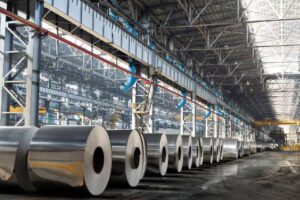
Explore our complete product line on our factory products page.
3. Primary Alloy Series and Industrial Applications
An established mill maintains continuous stock across standard international alloy series:
- 1000 Series (1050, 1060, 1100): Pure aluminum grades supplied by an industrial aluminum coil factory offer superior thermal and electrical conductivity for transformer windings and heat exchangers.
- 3000 Series (3003, 3105): Manganese-alloyed anti-rust coils provide high strength for roofing sheets, rain gutters, and ACP boards.
- 5000 Series (5052, 5083): Marine-grade magnesium alloys resist saltwater corrosion in shipbuilding and fuel tank applications.

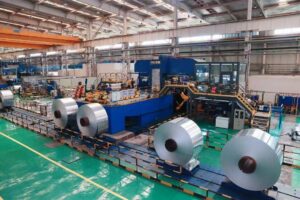
Caption:Bulk aluminum coils ready for export shipment
4. Industrial Material Specification Matrix
| Alloy Series | Key Grades | Tensile Strength (MPa) | Elongation (%) | Primary Applications |
|---|---|---|---|---|
| 1000 Series | 1050, 1060 | 65 – 145 | 15 – 35 | Transformers, HVAC Fin Stock |
| 3000 Series | 3003, 3105 | 120 – 215 | 8 – 25 | Roofing Sheets, Rain Gutters, ACP Boards |
| 5000 Series | 5052, 5083 | 190 – 345 | 10 – 22 | Marine Hulls, Pressure Vessels |
5. Quality Control Testing at our Industrial Aluminum Coil Factory
To ensure zero defect rates during stamping, continuous production lines undergo rigorous destructive and non-destructive quality checks.
Testing protocols include spectrometer chemical analysis, mechanical tensile checks, laser thickness scanning, and surface defect inspections.
Every shipment includes an official Mill Test Certificate (MTC EN 10204 3.1) verifying physical properties.
6. Seaworthy Packaging and Ocean Transport
Experienced exporters understand that ambient moisture causes water stain oxidation during long sea transit.
Export packaging incorporates heavy plastic wrapping, VCI anti-rust paper, active silica desiccants, and solid wooden pallets bound with steel strapping.
Read more about our shipping standards on our company profile page.
7. Frequently Asked Questions and Procurement Guidelines
When sending a purchasing inquiry to an industrial aluminum coil factory, specify: Alloy Grade, Temper, Gauge Thickness, Width, Inner Diameter (508mm/610mm), Max Coil Weight, and Incoterms.
Q1: How do I calculate total coil length?
A: Length (meters) = Net Weight (kg) / [Thickness (mm) × Width (meters) × 2.71].
Q2: What is the typical Minimum Order Quantity (MOQ)?
A: Standard production MOQs at an industrial aluminum coil factory range from 3 to 5 metric tons per specification.