
PPGI Roofing Sheel Basics

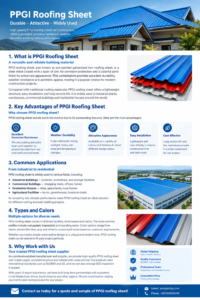
A modern roof needs to do more than simply cover a building. It must provide protection from rain, sunlight, wind, humidity, temperature changes and everyday environmental exposure. At the same time, architects, contractors and building owners increasingly want roofing materials that combine reliable performance with an attractive appearance.
PPGI roofing Sheel has become a widely used solution for these requirements. PPGI refers to pre-painted galvanized iron or, more accurately in many commercial applications, pre-painted galvanized steel. The steel substrate is protected by a metallic zinc coating and then finished with a carefully selected paint system.
This combination creates a roofing material that can provide corrosion protection, color options, formability and practical installation characteristics. It is commonly used for factories, warehouses, workshops, commercial buildings, agricultural structures and residential projects.
For buyers, however, choosing the right material requires more than simply asking for a price. Steel grade, thickness, zinc coating, paint system, color, profile, dimensions and manufacturing quality can all affect the final roofing performance.
This guide explains the most important factors buyers should understand before purchasing prepainted galvanized roofing products.
PPGI Roofing Sheet Structure
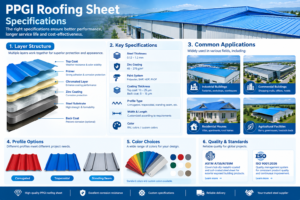
The performance of a prepainted roofing product begins with its layered structure. Although exact specifications vary between manufacturers and projects, a typical product consists of a steel substrate, metallic coating, pretreatment, primer and topcoat.
The steel substrate provides the basic mechanical strength of the sheet. The galvanized layer helps protect the steel from corrosion, while the paint system provides additional environmental protection and the desired surface appearance.
ASTM A755/A755M covers hot-dip metallic-coated and coil-coated steel sheet for exterior exposed building products. Its scope includes corrugated and other roll-formed configurations, which are commonly associated with roofing applications. The specification also recognizes different metallic-coated substrates and coating systems.
This layered construction explains why buyers should evaluate the entire coating system instead of focusing only on paint color or nominal thickness.
PPGI Roofing Sheel Benefits
One of the main reasons contractors choose prepainted galvanized roofing is the balance between protection, appearance and manufacturing flexibility.
Corrosion Protection
The galvanized coating provides a protective metallic layer over the steel substrate. When combined with a properly selected paint system, the roof can have enhanced resistance to outdoor exposure.
Actual service performance depends on the environment, coating specification, forming quality, installation and maintenance. Coastal, industrial and highly humid environments may require different coating systems from normal inland applications.
Weather Resistance
Roofing panels are exposed to changing weather throughout their service life. Rain, sunlight, humidity and temperature variation can gradually affect roofing materials.
A suitable coating system can help the roof maintain its appearance and protective function under expected service conditions. Buyers should therefore select coating specifications according to the actual project environment rather than choosing solely by color.
Attractive Appearance
Color is one of the most visible advantages of prepainted steel roofing. Manufacturers can supply a wide range of standard and customized colors, allowing roofing systems to coordinate with walls, doors, windows and other architectural elements.
For commercial and residential projects, color selection can be an important part of the overall building design.
Easy Processing
Coil-coated steel can be processed into different roofing profiles, including corrugated and trapezoidal configurations. The final profile should be selected according to structural requirements, span, drainage needs and local building practices.
Because the material is supplied as coated steel, manufacturers can produce finished roofing panels efficiently through roll forming and related processing operations.
PPGI Roofing Sheet Applications
The material is suitable for many construction scenarios because it can combine structural functionality with an architectural finish.
Industrial Buildings
Factories, workshops and warehouses often require large roof areas that can be manufactured and installed efficiently. Prepainted galvanized steel panels are frequently considered for these applications because they are available in different thicknesses, profiles and colors.
For large industrial projects, buyers should pay particular attention to panel length, roof slope, structural design, fastener compatibility and drainage.
Commercial Buildings
Retail buildings, offices, logistics facilities and other commercial structures may require roofing materials that provide both functional protection and a consistent appearance.
Color coated steel roofing can be coordinated with exterior walls and other building components to create a uniform architectural design.
Residential Projects
Residential roofing requirements vary significantly by climate, construction method and local standards. PPGI products can be used for houses, extensions, garages and other residential structures when the selected specification is suitable for the project.
In areas with strong sunlight, heavy rainfall or high humidity, coating performance and installation details deserve particular attention.
Agricultural Structures
Agricultural buildings such as barns, storage facilities and farm workshops also require practical roofing solutions. Material selection should consider humidity, chemical exposure, ventilation and the intended use of the building.
PPGI Roofing Sheet Specifications
Selecting the correct specification is one of the most important stages of purchasing.
Steel Thickness
Common commercial roofing thicknesses vary according to the manufacturer, profile and application. A thicker substrate generally provides greater material stiffness, but thickness should not be selected in isolation.
The structural design, profile geometry, support spacing and local requirements all influence the appropriate specification.
Buyers should clearly confirm whether the quoted thickness refers to the base steel thickness or another measurement convention.
Zinc Coating
The zinc coating is another important specification. A higher coating mass can provide additional metallic protection, but the appropriate level depends on the intended environment and product standard.
For this reason, purchasing documents should clearly identify the required coating specification rather than relying on general descriptions such as “high zinc” or “heavy coating.”
ASTM’s steel standards catalog includes specifications for zinc-coated steel and prepainted metallic-coated steel products, giving buyers useful references when establishing technical requirements.
Paint System
The paint system influences appearance, forming performance and resistance to environmental exposure.
Different projects may use different coating technologies, including polyester and other systems designed for specific performance requirements. ASTM A755/A755M identifies several types of organic topcoats used with prepainted metallic-coated steel, including polyester, silicone polyester, acrylic, fluoropolymer, plastisol and polyurethane.
Instead of asking only for a paint name, buyers should request the complete coating specification and technical data.
Profile
Roofing panels can be manufactured in different profiles. Corrugated and trapezoidal designs are common, while standing-seam systems may be selected for particular architectural or structural requirements.
The correct profile depends on factors such as drainage, structural span, support spacing, wind conditions and local construction practice.
PPGI Roofing Sheet Quality
Quality control should cover the complete manufacturing process rather than relying on a final visual inspection alone.
Important inspection points may include substrate thickness, coating weight, paint film thickness, color consistency, surface appearance, width, length, profile dimensions and mechanical properties.
For export projects, buyers should also confirm packaging requirements. Proper packaging helps reduce the risk of scratches, deformation and moisture-related problems during transportation and storage.
Quality management systems are also relevant when evaluating a manufacturer. ISO 9001 is a globally recognized quality management standard covering processes used to consistently meet requirements and improve organizational performance. ISO released the 2026 edition on September 16, 2026, replacing the previous edition as the current version.
For a buyer, certification alone should not replace product inspection. Technical specifications, test reports, samples and agreed inspection procedures should all be considered as part of supplier evaluation.
PPGI Roofing Sheet Installation
Even a high-quality roofing panel can perform poorly if it is installed incorrectly.
Before installation, contractors should confirm that the supporting structure is correctly aligned and that panel dimensions match the project drawings.
Fasteners should be compatible with the roofing system and installed according to the manufacturer’s recommendations. Over-tightening can damage the panel or washer, while insufficient tightening can create sealing problems.
Panel overlap is another important consideration. The required side lap and end lap depend on the profile, roof slope, weather conditions and local construction requirements.
Cutting should also be carried out carefully. Metal filings and sharp debris should be removed from the coated surface after cutting to reduce the possibility of staining or localized corrosion.
Storage is equally important. Roofing panels should be protected from prolonged exposure to standing water, condensation and contamination before installation.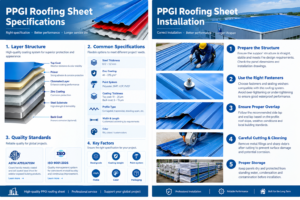
PPGI Roofing Sheet Buying Guide
A reliable purchasing process starts with a clear technical specification.
Before requesting quotations, buyers should prepare information covering:
- Base steel grade
- Steel thickness
- Zinc coating specification
- Paint system
- Paint film thickness
- Surface finish
- Color requirement
- Roofing profile
- Panel width
- Panel length
- Quantity
- Packaging method
- Delivery destination
- Required inspection documents
For international orders, buyers should also clarify the commercial terms, loading method, container requirements and documentation.
Price should be evaluated together with the complete specification. Two quotations may look similar while using different steel thicknesses, zinc coatings, paint systems or packaging standards.
A professional supplier should be able to provide a detailed quotation instead of offering only a price per ton.
PPGI Roofing Sheet Supplier Selection
Supplier selection is especially important for distributors, contractors and construction-material importers.
A capable supplier should be able to communicate technical specifications clearly, provide product samples when required and maintain consistent production quality.
Buyers should also examine production capacity, quality-control procedures, export experience, packaging methods and after-sales communication.
For international construction-material purchases, stable supply can be just as important as the initial quotation. A supplier that can maintain consistent specifications across repeated orders can help distributors and contractors reduce procurement uncertainty.
For more information about related steel products, you can explore our steel coil products and solutions and compare different coated-steel options according to your project requirements.
PPGI Roofing Sheet Standards
Technical standards can help buyers establish clearer purchasing specifications.
ASTM A755/A755M specifically addresses hot-dip metallic-coated and coil-coated steel sheet for exterior exposed building products. The standard explains that substrate properties, organic coating systems and forming methods can influence the expected performance and appearance of the final product.
For quality management, buyers can also refer to the official ISO 9001 quality management standard, which provides a framework for establishing and continually improving a quality management system.
These references are useful when preparing technical specifications, supplier qualification documents and inspection requirements.
PPGI Roofing Sheet Cost Factors
The final purchase price is influenced by several variables rather than a single material cost.
Major factors include the base steel price, substrate thickness, zinc coating, paint system, color, profile, order quantity, packaging, production requirements and freight.
For custom colors or special coating systems, minimum order quantities and additional production requirements may also affect the quotation.
Buyers should therefore compare quotations based on equivalent specifications. A lower price does not necessarily represent a lower total procurement cost if the material specification, coating performance or packaging is different.
For distributors, another important consideration is consistency. A stable product specification makes it easier to quote projects, manage inventory and maintain customer expectations.
PPGI Roofing Sheet Export Service
International buyers normally need more than a roofing product. They also need dependable communication, documentation and logistics coordination.
A professional export supplier should be able to support customers with technical confirmation, production scheduling, quality inspection, packaging and shipment coordination.
For containerized orders, coil or sheet packaging should be designed to reduce movement and moisture exposure during transportation. Loading arrangements should also consider the destination port, unloading equipment and final delivery conditions.
For repeat customers, maintaining the same technical specification from order to order can help improve purchasing efficiency.
PPGI Roofing Sheet for Global Projects
The requirements for roofing materials differ between markets. Buyers in the Middle East may focus strongly on heat, sunlight and outdoor exposure, while customers in humid or coastal regions may place greater emphasis on corrosion protection and coating selection.
South American, African and Asian markets can also have different construction practices, color preferences, profile requirements and transportation conditions.
This is why a project-specific specification is generally more useful than a generic product description.
A good supplier should ask questions about the application, environment, profile, thickness, coating and quantity before providing a final quotation.
PPGI Roofing Sheet Final Checklist
Before confirming an order, buyers can use the following checklist:
- Confirm the base steel grade.
- Confirm the exact substrate thickness.
- Confirm zinc coating requirements.
- Confirm the paint system and film thickness.
- Confirm color and surface finish.
- Confirm roofing profile and dimensions.
- Confirm quantity and tolerance.
- Confirm packaging requirements.
- Confirm inspection and testing documents.
- Confirm shipping and delivery terms.
This process can help reduce misunderstandings between the buyer, manufacturer and construction team.
PPGI Roofing Sheet Conclusion
PPGI roofing sheet combines a metallic-coated steel substrate with a prepainted surface system, making it a practical material for many roofing and building applications.
Its usefulness comes from the combination of corrosion protection, appearance, processing flexibility and availability in different specifications. However, product quality should always be evaluated according to the complete technical specification rather than one feature alone.
For buyers, the most important factors include steel thickness, zinc coating, paint system, profile, dimensions, quality control, packaging and supplier reliability.
Whether the project involves a warehouse, factory, commercial building, agricultural structure or residential property, selecting the correct coated-steel specification is essential.
If you are sourcing PPGI roofing products for an international project, prepare your required thickness, coating, color, profile, quantity and destination before requesting a quotation. This allows the supplier to provide a more accurate technical and commercial proposal.