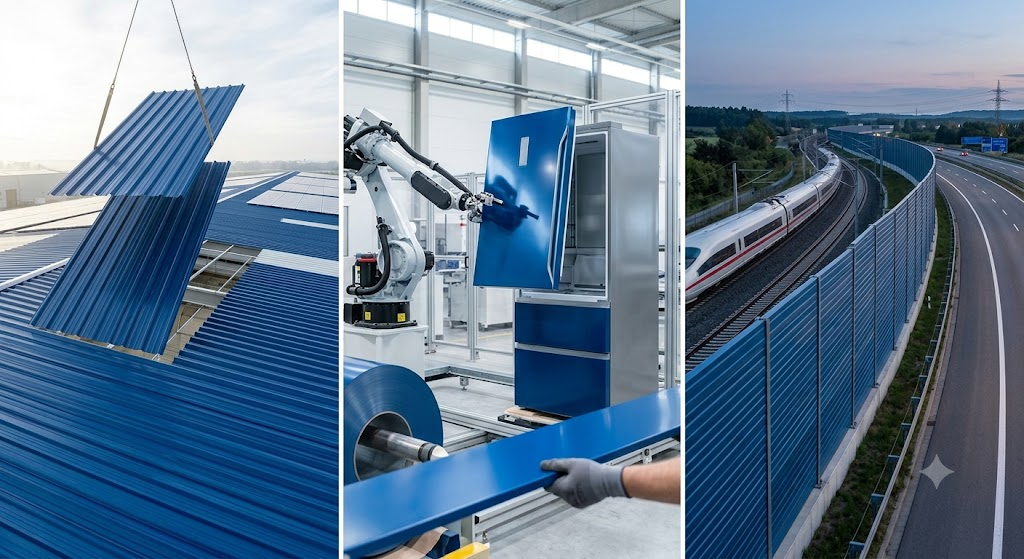
In the fast-evolving landscapes of modern architecture, industrial manufacturing, and infrastructure development, choosing materials that balance aesthetic appeal with long-term structural integrity is paramount. Among the elite class of advanced composite materials, prepainted galvanized steel coils have emerged as an industry benchmark.
Commonly referred to in the international metal markets as PPGI, this material is highly valued for its superior corrosion resistance, versatile color palettes, and immediate readiness for deep processing. By replacing the traditional “fabricate then paint” workflow with a streamlined “pre-coated” blueprint, global enterprises are significantly cutting down operational costs while upgrading product lifespans.
However, navigating the global metal supply chain presents a unique set of challenges. With a massive array of substrate variations, chemical coat formulations, and competing price points, making an informed procurement decision requires deep technical insight. This comprehensive guide breaks down the sourcing matrix into 5 essential factors to help procurement managers and structural engineers secure high-performance materials for their specific project demands.
Decoding the Anatomy and Structural Benefits of Pre-Coated Steel
What Exactly is a Color Coated Metal Coil?
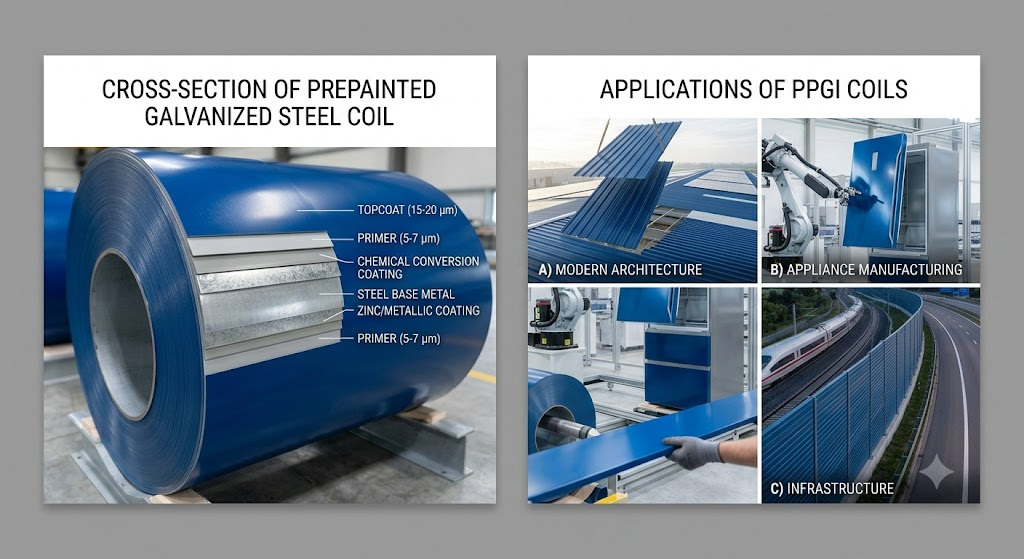
At its core, premium prepainted galvanized steel coils function as a sophisticated multi-layer composite system. The production process begins with a metallic-coated steel base (usually hot-dip galvanized, galvalume, or electro-galvanized steel). This base metal undergoes a meticulous continuous coil coating process.
- Surface Pre-treatment: The substrate is chemically cleaned and brushed to remove any mill scale, oils, or oxides, followed by the application of a chemical conversion layer to maximize paint adhesion.
- Primer Application: A high-performance primer is applied to both sides to establish a robust chemical bond and provide secondary corrosion protection.
- Topcoat Baking: The visible face receives its functional and decorative topcoat, which is then cured at precise high temperatures in specialized baking ovens.
The Economic and Environmental Advantages
Shifting from post-production spray painting to utilizing pre-painted metal coils yields monumental strategic benefits for manufacturers:
- Elimination of Eco-Hazards: Industrial spraying operations face rigorous VOC (Volatile Organic Compound) emission regulations. Outsourcing the coating phase to a specialized coil manufacturer shifts the regulatory and environmental compliance burden.
- Flawless Mechanical Flexibility: The specialized paint systems applied to prepainted galvanized steel coils during production are highly elastic. They are designed to withstand extreme roll forming, bending, stamping, and shearing without exhibiting micro-cracking, peeling, or paint delamination.
- Uniformity and Aesthetic Precision: Continuous automated line coating ensures an ultra-precise, uniform dry film thickness (DFT) across the entire width and length of the steel strip, removing the risk of runs, sags, or uneven shading common in manual spraying.
Substrate Selection for Prepainted Galvanized Steel Coils: The Foundation of Longevity
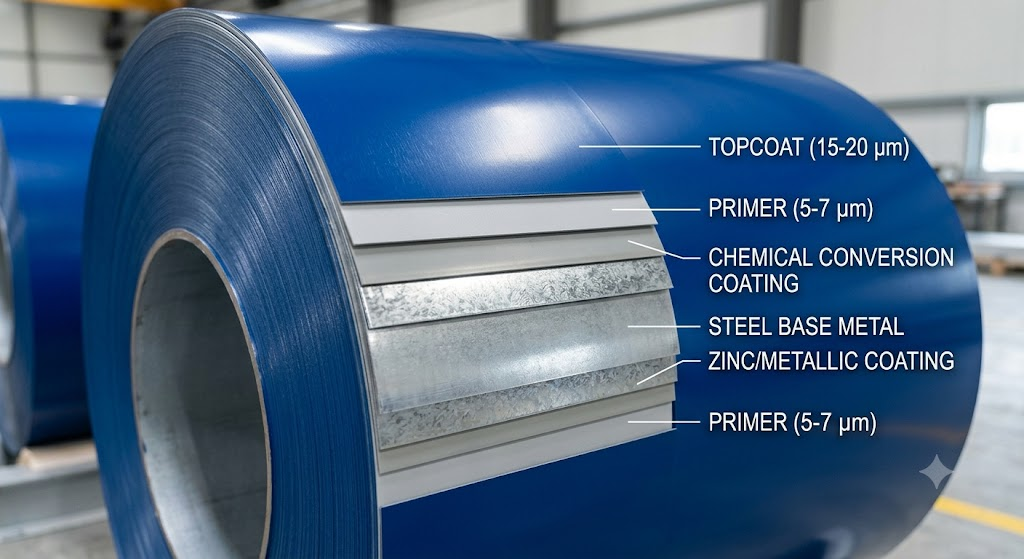
| Topcoat (15‑20 μm) |
| Primer (5‑7 μm) |
| Chemical Conversion Coating |
| Zinc/Metallic Coating Layer |
| Steel Base Metal |
1. Hot-Dip Galvanized Substrate (GI)
This is the most widely utilized baseline for general manufacturing. The steel is passed through a molten zinc bath, creating a protective zinc layer. When coated with paint, it forms a highly effective dual-protection shield. It is highly cost-effective for standard indoor partitions, consumer appliance panels, and general warehousing in mild environments.
2. Galvalume or Aluzinc Substrate (GL)
Featuring a metallic coating composition of approximately 55% Aluminum, 43.4% Zinc, and 1.6% Silicon, galvalume substrates offer exceptional thermal reflectivity and barrier protection. Under identical atmospheric exposures, a painted galvalume base can outlast a standard galvanized base by two to four times, making it the premier choice for coastal roofing and heavy industrial complexes.
3. Zinc-Aluminum-Magnesium Substrate (ZAM)
The pinnacle of modern substrate engineering, ZAM steel contains an alloy layer that forms a highly dense protective film over time. Its most remarkable feature is its “self-healing” cut-edge protection. When exposed to the elements, the magnesium ions migrate to form a stable zinc carbonate compound over exposed sheared edges, halting rust in its tracks. This is highly recommended for solar tracking arrays, agricultural livestock housing, and highly corrosive maritime environments.
Selecting the Optimal Paint System for Diverse Climatic Demands
The organic topcoat acts as the primary barrier against ultraviolet (UV) radiation, chemical fallout, acid rain, and mechanical abrasion. Choosing the correct resin type prevents premature chalking, fading, and degradation.
1. Regular Modified Polyester (PE)
Polyester remains the most utilized coating globally due to its balance of affordability, flexible forming traits, and broad color accessibility.
- Optimal Uses: Indoor ceiling grids, temporary site offices, sandwich panel backing sheets, and environments with low UV exposure.
- Service Life: Generally offers an operational lifespan of 7 to 10 years before noticeable fading occurs in standard temperate zones.
2. Silicon Modified Polyester (SMP)
By chemically modifying polyester resin with an infusion of silicone (typically 20% to 30%), the hardness, scratch resistance, and thermal endurance of the coating are substantially elevated.
- Optimal Uses: Agricultural structures exposed to animal waste gasses, high-temperature industrial baking zones, and regions experiencing sharp seasonal temperature swings.
3. High-Durability Polyester (HDP)
HDP utilizes high-molecular-weight resins combined with premium inorganic ceramic pigments. This specific formulation drastically retards the rate of UV photo-oxidation.
- Optimal Uses: Public infrastructure, massive logistics hubs, and sunny, high-radiation geographic sectors like plateaus or tropical inland plains.
- Service Life: Engineered to deliver reliable color retention and chalking resistance for upwards of 15 years.
4. Polyvinylidene Fluoride (PVDF)
Formulated with a strict 70/30 ratio of fluorocarbon resin to acrylic resin, PVDF represents the gold standard in premium architectural coatings. The carbon-fluorine bond is one of the strongest chemical bonds known to science, providing absolute immunity to aggressive chemical solvents and intense solar radiation.
- Optimal Uses: Iconographic high-rise facades, airport terminals, coastal power plants, and regions plagued by severe industrial smog or acid rain.
- Service Life: Keeps its aesthetic brilliance and structural seal intact for 20 to 25+ years without substantial degradation.
Crucial Manufacturing Metrics and Quality Assurance Standards
To ensure the material you receive matches your exact operational specifications, you must monitor several critical technical quality parameters during factory acceptance testing.
1. Paint Film Thickness Verification
The industry benchmark for standard exterior-facing architectural panels dictates a double-coat, double-bake (2/2) structure:
- Top Face System: A 5–7 $\mu m$ primer coupled with a 15–20 $\mu m$ topcoat, establishing a total Dry Film Thickness (DFT) of $\ge$ 20–27 $\mu m$.
- Back Face System: A service or epoxy back coat ranging from 5–12 $\mu m$, tailored to either bond optimally with polyurethane insulation foam or resist scratching during transit.
Therefore, global builders prefer importing durable prepainted galvanized steel coils to ensure the structural safety of large-scale industrial roofing projects
2. Formability and Mechanical Testing Protocols
Before approving high-volume production lots, manufacturers of prepainted galvanized steel coils` subject sample strips to strict stress testing.
- The T-Bend Test: The metal strip is folded over itself repeatedly ($0T, 1T, 2T, 3T$). A high-tier product should show zero paint peeling or cracking under a $2T$ or $3T$ specification.
- The MEK Rub Test: Utilizes Methyl Ethyl Ketone solvent on a cotton swab rubbed vigorously across the surface to evaluate the level of paint curing. A passing grade typically requires over 100 double rubs without exposing the primer.
- Impact Testing: Dropping a standard weight from a calibrated height onto the reverse side of the panel to simulate sudden jobsite impacts, ensuring the paint maintains its adhesion even under localized deformation.
B2B Sourcing Strategy: Eliminating Pitfalls in Global Procurement
When managing large-scale procurement contracts with overseas mills or international trading networks, focusing solely on the lowest price per metric ton can lead to costly structural failures down the line.
1. Identifying and Avoiding Common Vendor Deceptions
Some low-tier suppliers try to lower their production costs through methods that are difficult to spot during a basic visual inspection:
- Reducing Coating Mass: A vendor might offer a competitive quote by silently dropping the zinc coating mass from an industry-standard $Z140$ ($140g/m^2$) down to a substandard $Z60$. While it looks identical on day one, the sheet will begin rusting within a fraction of its intended lifespan.
- Using Substandard Pigments: Swapping out expensive, stable inorganic ceramic pigments for cheap organic dyes causes rapid fading and severe chalking within 24 months of sun exposure.
When you buy prepainted galvanized steel coils from global markets, focusing solely on the lowest price per metric ton can lead to costly structural failures down the line.
2. Drafting an Explicit Technical Purchase Specification
To safeguard your investment and guarantee quality consistency when buying prepainted galvanized steel coils, always define the following specific engineering metrics.
- Steel Grade Requirements: Clearly state the mechanical steel grade needed for your machinery(e.g., commercial forming grade DX51D+Z, or high-strength structural grade S350GD+AZ defined by the <a href=”https://www.en-standard.eu/” target=”_blank” rel=”noopener”>European Standards (EN 10346)</a>).
- Metallic Coating Mass: Clearly specify the target zinc or galvalume mass (e.g., AZ150, which guarantees $150g/m^2$ of aluminum-zinc alloy coating).
- Paint Manufacturer and Line Certification: Demand recognizable, tier-one paint brands (such as <a href=”https://www.akzonobel.com/” target=”_blank” rel=”noopener”>AkzoNobel</a> or <a href=”https://www.ppg.com/” target=”_blank” rel=”noopener”>PPG</a>) and request accredited laboratory test certificates covering salt spray resistance and accelerated UV weathering tests.
- Seaworthy Packaging Requirements: Standard vertical (eye-to-sky) or horizontal (eye-to-wall) packaging must incorporate heavy-duty waterproof paper, a protective steel outer shell, robust steel strapping, and moisture-absorbing desiccant packs to prevent transit rust or saltwater corrosion inside cargo containers.
Comprehensive Summary
Investing in high-performance prepainted galvanized steel coils is one of the most effective ways for modern enterprises to optimize production efficiency, reduce environmental compliance costs, and deliver visually stunning, long-lasting products. By understanding how different steel substrates, zinc coating weights, and resin technologies interact, procurement teams can protect their supply chains from low-quality substitutes and maximize their long-term returns.
If you are currently mapping out your upcoming manufacturing schedule or structural project, contact our technical consulting division today. Our experienced team will evaluate your local environment, structural loads, and budget to design a tailored material solution built for lasting performance.
If you need a quick quote, please feel free to [Contact Our Sourcing Experts].
Our professional sales team will reply within 24 working hours and offer full technical parameter support for your whole project.
Email: jenny@sbtgi.com
WhatsApp: +86 13905436749
Official Website: www.sbtgi.com