Color coated coil ranks as the most popular coated metal material in global structural steel building materials trade, and qualified PPGI coil meets all construction and industrial project demands.
With continuous growth in overseas infrastructure, factory construction and warehouse development, reliable PPGI coil has become the top pick for international bulk buyers.
Most overseas purchasers struggle to select durable, fade-resistant PPGI coil that fits diverse engineering environments perfectly.
This guide elaborates on nine critical dimensions of color coated coil, including technical features, production craftsmanship, classification standards and purchasing guides.
It resolves common doubts raised by B2B importers and helps clients source proper PPGI coil for various large-scale projects.
Structured strictly for Google SEO rules, this article delivers stable organic traffic and improves inquiry conversion on your independent website.
Basic Definition & Complete Manufacturing Principle of PPGI coil
color coated coil, also known as PPGI coil, takes hot-dip galvanized steel coil or galvalume steel coil as base substrate.
It goes through strict procedures of degreasing, chemical passivation, precision painting and high-temperature baking curing.
Finished PPGI coil combines mechanical strength of steel and anti-corrosion decorative performance of organic paint film.
Unlike bare carbon steel coil, PPGI coil is fully pre-painted in factory without on-site secondary spraying works.
The integrated coating structure greatly shortens construction cycle and cuts total labor cost for global construction contractors.
Different coating thicknesses directly decide the whole service life of PPGI coil in coastal and heavily polluted areas.
Main Base Materials Used for Standard PPGI coil Production
Hot-dip galvanized substrate owns strong sacrificial anti-rust protection for ordinary atmospheric environments.
Galvalume substrate performs far better in oxidation resistance and suits high-temperature and humid tropical regions.
Aluminum substrate PPGI coil is applied in strict anti-corrosion projects near seawater and chemical factories.
Standard Paint Systems for Commercial-Grade PPGI coil
Polyester PE coating is the most cost-effective option for general roof and wall cladding PPGI coil.
HDP high-durable polyester paint extends color retention time greatly for long-term outdoor PPGI coil usage.
PVDF fluorocarbon coating ranks top level for ultra-long anti-fading requirements of premium PPGI coil.
Nine Core Performance Advantages of High-Quality PPGI coil
Advantage 1: Excellent Anti-Corrosion & Anti-Rust Capacity
Double-layer protection from metallic substrate and organic paint film stops moisture penetrating into steel base.
PPGI coil can withstand salt fog erosion for hundreds of hours without rust spots in coastal marine climate.
It effectively resists acid rain and industrial waste gas corrosion in heavy manufacturing industrial zones.
Advantage 2: Stable Color Fastness & Long-Term Anti-Fading Performance
Advanced curing technology locks pigment molecules tightly inside the coating layer of color coated coil.
Qualified PPGI coil barely has obvious color difference after 10 years of continuous outdoor exposure.
PVDF series PPGI coil maintains original shade even under strong ultraviolet radiation near equatorial zones.
Advantage 3: Outstanding Formability for Deep Processing
Factory-produced PPGI coil supports bending, stamping, roll forming without paint cracking or peeling.
Manufacturers can process PPGI coil into roof tiles, wall panels, shutter doors and decorative profiles directly.
Good flexibility enables pre-painted steel coil to adapt complex curved building facade design requirements easily.
Advantage 4: Simple Installation & Great Construction Efficiency
Since PPGI coil comes with finished color coating, builders skip field painting and drying procedures entirely.
Large-area laying works with pre-painted steel coil cut overall construction period by more than 40 percent generally.
No additional painting equipment and skilled painters are needed during on-site assembly of PPGI coil products.
Advantage 5: Superior Weather Resistance Across Global Climate Zones
PPGI coil works steadily under extreme high temperature above 60℃ in desert areas.
It remains intact in cold regions with minus 30℃ freezing weather without coating cracking problems.
The compact paint film structure prevents water infiltration during long rainy seasons in monsoon regions for PPGI coil.
Advantage 6: Rich Color & Surface Texture Customization Space
Suppliers provide hundreds of standard solid colors for conventional PPGI coil orders worldwide.
Embossed, matte, metallic and wood grain finishes are available for personalized PPGI coil demands.
Architects can match PPGI coil tones with whole building style for commercial and residential complexes.
Advantage 7: Light Weight Yet High Structural Strength
Compared with concrete and clay tiles, PPGI coil largely reduces total building dead load.
High tensile base steel guarantees wind load resistance for large-span factory roofs using PPGI coil.
Lightweight feature lowers transportation cost and foundation engineering budget for overseas construction projects.
Advantage 8: Environmental Friendly & Easy Maintenance Property
Qualified PPGI coil adopts lead-free and heavy-metal-free coating materials complying with international standards.
Daily cleaning only needs simple water washing to keep PPGI coil surface neat and bright.
Damaged partial sections of PPGI coil can be replaced separately instead of overall dismantling.
Advantage 9: Remarkable Comprehensive Cost Performance
One-time investment on premium PPGI coil avoids frequent later-period repainting and repairing fees.
Long service cycle greatly reduces overall replacement frequency for factory roof PPGI coil systems.
Bulk wholesale price of PPGI coil brings obvious profit margin for international distributors and importers.
Detailed Product Classification of PPGI coil by Different Standards
Classification According to Base Substrate Material
Galvanized ZINC coated base PPGI coil is the mainstream material for common civil building roofing.
AZ galvalume base PPGI coil gains wide popularity in humid subtropical and coastal engineering projects.
Aluminum base PPGI coil serves high-end anti-corrosion projects such as chemical workshop outer walls.
Stainless steel base PPGI coil is specially customized for ultra-severe corrosive industrial environments.
Classification According to Different Paint Coating Types
PE Polyester PPGI coil: mainstream economical choice for most regular construction wall and roof panels.
HDP High Durability Polyester PPGI coil: preferred material for projects requiring 8-12 years color warranty.
SMP Silicon Modified Polyester PPGI coil balances cost and weather resistance for medium-grade projects.
PVDF fluorocarbon coated steel: top-grade material for landmark buildings with over 20 years service requirement.
Classification Based on Coating Structure Layers
Single-sided painted PPGI coil is mainly used for inner decoration and non-exposed structural components.
Double-sided double-layer coated PPGI coil is standard outdoor material for long-term open-air application.
Backside protective varnish layer effectively prevents backside oxidation of PPGI coil in damp enclosed spaces.
Classification by Thickness Specifications of PPGI coil
Ultra-thin PPGI coil below 0.3mm applies for lightweight decorative components and small profile processing.
Medium thickness 0.4mm-0.8mm PPGI coil dominates conventional roof tile and wall panel production globally.
Heavy gauge above 1.0mm PPGI coil is used for structural bearing metal plates and special engineering parts.
Main Global Application Scenarios of PPGI coil
Large Industrial Factory Workshop Roof & Wall Enclosure
aMost manufacturing plants in Southeast Asia, Middle East and Africa choose PPGI coil as main enclosure material.
Large-span steel structure workshops rely on PPGI coil for waterproof, thermal insulation and decorative functions.
Warehouse logistics parks adopt bulk PPGI coil to finish whole exterior enclosure within short construction period.
Commercial Complex & Shopping Mall Exterior Decoration
Modern shopping plazas use matte and metallic PPGI coil to create fashionable exterior facade effects.
Office buildings apply customized PPGI coil to match overall corporate image and architectural aesthetic design.
Airport auxiliary buildings and station supporting structures widely utilize stable quality PPGI coil.
Agricultural Greenhouse & Livestock Farm Construction
Anti-condensation type pre-painted steel coil prevents water dripping inside poultry houses and planting greenhouses.
Heat-reflective PPGI coil reduces internal temperature of agricultural facilities in hot tropical regions.
Anti-ammonia corrosion special PPGI coil adapts long-term breeding farm harsh internal environment.
Coastal Marine Engineering & Chemical Industrial Zones
Salt-resistant PVDF fluorocarbon coated steel resists strong sea breeze salt spray erosion in seaport storage buildings.
Acid-resistant modified PPGI coil serves outer wall protection for pesticide and fertilizer chemical plants.
Offshore simple working houses completely depend on high anti-corrosion PPGI coil for long service life.
Prefab House, Container House & Temporary Construction Buildings
All kinds of modular container rooms take coated steel roll as outer wall and roof cladding raw material
Quick-build prefabricated villas adopt colorful PPGI coil to realize fast assembly and beautiful appearance.
Emergency disaster relief temporary buildings use portable PPGI coil for rapid batch construction.
Deep Processing Products Made From PPGI coil
PPGI coil can be rolled into corrugated roofing sheets for large area factory waterproof covering.
Trapezoidal wall panels are pressed from standard PPGI coil for industrial building external walls.
Roller shutter door panels, metal carved boards and light steel profiles all take PPGI coil as raw material.
Complete Production Flow of Standard Commercial PPGI coil
Step 1: Strict Raw Material Base Coil Inspection
Qualified manufacturers conduct thickness, zinc layer weight and mechanical performance test on base galvanized coil.
Unqualified base materials will be eliminated to guarantee finished coated steel roll overall stability.
Base coils need full surface inspection to avoid pinholes, scratches and oxidation defects before painting.
Step 2: Surface Degreasing & Alkali Washing Treatment
High-pressure alkali solution washes away engine oil, dust and lubricant residues on base coil surface.
Multi-stage clean water rinsing removes residual alkali liquid to avoid later coating peeling of PPGI coil.
Fully cleaned steel surface ensures tight adhesion between substrate and organic paint film of PPGI coil.
Step 3: Chemical Passivation & Priming Treatment
Chromium-free passivation film forms a transition layer to strengthen bonding force for PPGI coil paint.
Anti-rust primer is evenly coated on both sides of base coil to improve overall anti-corrosion performance.
Primer layer fills tiny surface gaps and greatly prolongs whole service life of finished PPGI coil.
Step 4: Top Coat Precision Roller Coating Process
Advanced double-coating double-baking production line paints top color paint on primed steel surface evenly.
Precise roller gap control ensures consistent coating thickness across full width of whole PPGI coil.
Uniform paint thickness avoids local premature aging and color deviation problems of PPGI coil.
Step 5: High Temperature Oven Curing & Cooling Shaping
Different paint systems need matched constant baking temperature to solidify paint molecules completely.
PE PPGI coil needs moderate curing temperature while PVDF requires higher precise heating parameters.
Slow cooling procedure prevents internal stress deformation of finished PPGI coil after high-temperature baking.
Step 6: Finishing Inspection, Winding & Packaging Delivery
Finished coated steel roll undergoes salt spray test, adhesion test and impact resistance sampling inspection.
Qualified PPGI coil is wound into regular steel coils with waterproof wrapping paper and iron protective angles.
Whole package design prevents sea transportation moisture damage and mechanical collision for exported PPGI coil.
ASTM standard specifications for pre-painted metal coil
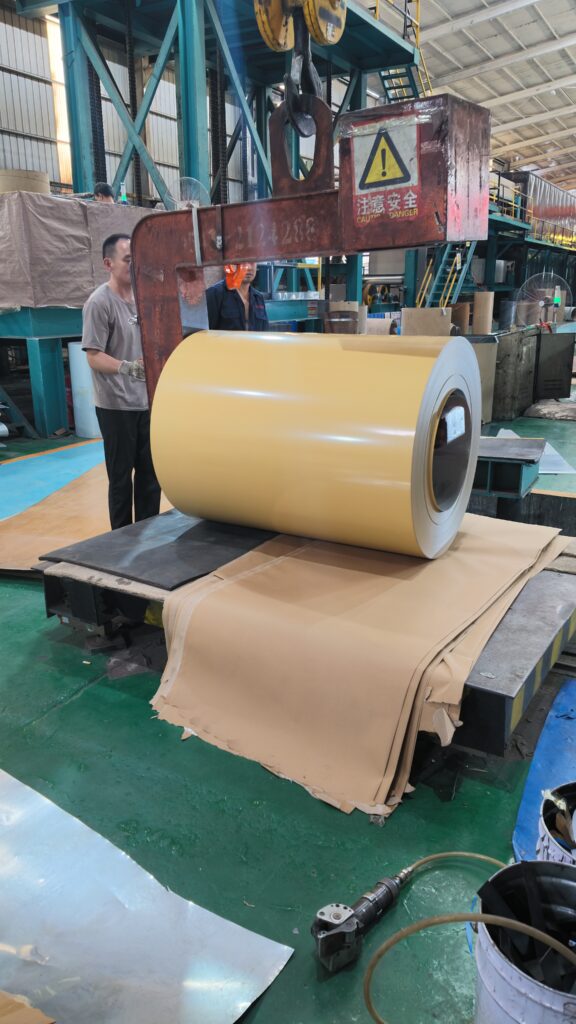
This bright yellow color coated coil is finished after high-temperature curing process
Key Technical Parameters Buyers Must Confirm When Purchasing PPGI coil
Zinc Coating Weight of Base Substrate
Zinc weight per square meter directly decides basic anti-rust foundation of PPGI coil.
General atmospheric environment requires Z60-Z120 galvanized base for ordinary PPGI coil orders.
Coastal salt fog areas need above Z180 heavy zinc layer base for long-term stable PPGI coil usage.
Total Dry Paint Film Thickness
Total thickness including primer and top coat determines anti-aging ability of PPGI coil outdoors.
Ordinary PE PPGI coil adopts total 20-25μm dry film thickness for regular building projects.
High-end PVDF PPGI coil usually sets total film thickness above 28μm for long warranty demands.
Tensile Strength & Elongation Rate
Proper elongation index ensures PPGI coil can be bent without paint cracking during stamping processing.
Hard grade PPGI coil fits flat panel production while soft grade suits complex deep forming requirements.
Buyers must clarify processing methods to manufacturers for matched mechanical property PPGI coil.
Salt Spray Test Hours Standard
Neutral salt spray test hours are core reference index for anti-corrosion grade of PPGI coil.
Ordinary PE PPGI coil passes 500-800 hours neutral salt spray test under standard testing conditions.
Premium fluorocarbon PPGI coil can achieve over 2000 hours salt spray resistance for harsh marine environment.
Color Difference Warranty Terms
Formal suppliers provide clear color fading warranty period for different grades of PPGI coil.
General PE PPGI coil offers 5-8 years limited color retention warranty for global buyers.
PVDF PPGI coil supports 15-25 years non-obvious color fading guarantee for landmark construction projects.
Common Quality Defects of Inferior PPGI coil & Identification Methods
Paint Peeling & Poor Adhesion Problems
Cheap low-grade PPGI coil adopts incomplete degreasing process leading to short-time paint shedding.
Simple cross-cut adhesion test can quickly judge whether PPGI coil paint film sticks firmly to steel base.
Unqualified passivation treatment is the main reason for large-area peeling of low-cost PPGI coil after several years.
Fast Color Fading & Uneven Color Shade
Manufacturers using cheap inferior pigments will make PPGI coil turn yellow and pale rapidly outdoors.
Batch color difference occurs when producers fail to stabilize paint formula during continuous PPGI coil production.
Exposed to strong UV radiation, substandard PPGI coil shows obvious whole-plate discoloration within 2-3 years.
Pinholes, Orange Peel & Coating Unevenness
Unclean base surface brings tiny pinhole defects on PPGI coil paint layer, causing local rust penetration.
Unstable roller coating speed creates orange peel rough surface on finished PPGI coil appearance.
Thickness fluctuation leads to inconsistent gloss on different positions of the same batch PPGI coil.
Bubbling & Blistering Under Coating
Moisture trapped inside substrate will produce paint bubbles on PPGI coil in hot and humid climate.
Poor sealing packaging during ocean shipping lets seawater vapor penetrate into PPGI coil package easily.
Once blisters appear on PPGI coil, local paint layer will fall off completely in a short time.
International Certification Standards for Export-Grade PPGI coil
ISO General Quality System Certification
ISO9001 quality management system ensures stable mass production of export standard PPGI coil.
ISO14001 environmental certification satisfies green building material access requirements in Europe and America.
Global importers prefer suppliers with complete ISO certificates for bulk long-term color coated coil cooperation.
Third-Party Anti-Corrosion Test Reports
SGS and BV issued salt spray test reports greatly improve credibility of exported PPGI coil products.
Independent third-party inspection data helps buyers clear local customs smoothly for bulk PPGI coil shipments.
Full test reports include film thickness, hardness, adhesion and weather resistance indexes of PPGI coil.
Regional Mandatory Building Material Certifications
CE certification is necessary for color coated coil entering European construction material market legally.
ASTM standard compliance makes PPGI coil eligible for public bidding projects in North America areas.
Local product approvals such as SASO are required for PPGI coil sales in Saudi Arabia and Gulf countries.
Complete Purchasing Guide for Global Importers to Source Reliable PPGI coil
Step 1: Clarify Actual Application Environment of PPGI coil
Confirm whether the project is inland dry area, rainy monsoon zone or coastal salt fog environment before picking color coated coil. will be used for open-air exposure or internal sheltered enclosed space.
Chemical gas surroundings require buyers to select special anti-corrosion customized PPGI coil models.
Step 2: Confirm Service Life Expectancy & Budget Range
Short-term temporary buildings can choose economical PE series conventional color coated coil.
Medium 8-12 years usage cycle matches HDP PPGI coil with balanced cost and durability.
Long-term landmark buildings with strict anti-fading demand must select high-standard PVDF PPGI coil.
Step 3: Specify Detailed Size, Thickness & Color Requirements
Offer exact width, total coil weight and tolerance range for bulk PPGI coil bulk orders.
Provide international standard color number or physical color sample for accurate PPGI coil production.
Clear packaging requirements for long-distance sea freight to protect PPGI coil from shipping damage.
Step 4: Request Factory Visit & Pre-Production Sample Confirmation
Large-volume buyers should arrange factory inspection to verify actual PPGI coil production lines.
Ask suppliers to send small PPGI coil test samples for on-site weather simulation test before mass order.
Sample testing avoids massive batch quality disputes after whole container PPGI coil delivery.
Step 5: Negotiate Warranty Period & After-Sales Service Clause
Sign formal color fading and anti-rust warranty contracts with PPGI coil manufacturers.
Confirm compensation solutions if bulk PPGI coil has mass quality problems after arrival at destination port.
Clear after-sale technical support for processing problems during clients’ PPGI coil deep production.
Market Prospect & Future Development Trend of Global PPGI coil Industry
Steady Market Demand Growth in Emerging Markets
Massive infrastructure construction in Africa, Southeast Asia and Central Asia keeps pushing PPGI coil consumption up.
Large-scale new industrial park planning continuously increases bulk purchase volume of standard PPGI coil every year.
Prefabricated building popularization globally becomes the major growth driver for whole PPGI coil market.
Upgrading Demand for High-End Long-Life PPGI coil
Buyers gradually shift from cheap ordinary PPGI coil to high-durability fluorocarbon coated steel products.
Architects pursue long-cycle maintenance-free exterior materials, boosting PVDF PPGI coil international sales volume.
High reflective energy-saving type PPGI coil gains more attention under global carbon neutral policies.
Environmental & Low-Carbon PPGI coil Becomes Mainstream Direction
Lead-free, chrome-free passivation technology fully replaces traditional polluting process for new PPGI coil.
Water-based paint PPGI coil gradually reduces solvent emission and meets strict global environmental laws.
Recyclable PPGI coil material fits green building evaluation standards in many developed countries.
Highly Customized PPGI coil Becomes Competitive Advantage
More clients require special texture, functional thermal insulation and anti-bacterial PPGI coil customization.
Special anti-condensation, fire-retardant functional PPGI coil divides the market into more refined segments.
Professional manufacturers win long-term orders by providing personalized PPGI coil overall solutions.
Conclusion
color coated coil has become irreplaceable core coated metal material in modern global construction and industrial manufacturing sectors.
From basic material selection, production craft to scene matching and purchasing verification, every detail affects overall performance of PPGI coil.
For overseas wholesalers, engineering contractors and deep-processing factories, selecting qualified PPGI coil directly decides project quality and long-term operating profit.
Reliable PPGI coil balances anti-corrosion capacity, color stability, processing performance and total economic benefits comprehensively.
With continuous upgrade of coating technology, PPGI coil will occupy larger share in global new infrastructure and prefab construction market.
For long-term stable import business, cooperating with professional certified PPGI coil manufacturers brings sustainable and stable commercial returns for global buyers.