Introduction
The global metallurgical and manufacturing sectors constantly demand materials that balance mechanical strength, cost-efficiency, and long-term durability. Among the myriad of options available, Galvanized Steel Coils (GI Coils) stand out as an indispensable cornerstone of modern industrial growth. From the high-rise skyscrapers reshaping urban skylines to the precise internal components of everyday household appliances, galvanized steel provides the invisible yet robust shield that keeps our world moving forward.
However, navigating the global steel market is no simple task. Procurement managers, structural engineers, and factory owners often face a barrage of technical jargon: HDGI vs. EG, DX51D vs. SGCC, spangle optimization, zinc coating mass (g/m
2
), and passivation methods. Selecting the wrong specification can lead to catastrophic structural failure, premature rust, or thousands of dollars in wasted capital.
This definitive, 3000+ word comprehensive guide is designed to serve as your ultimate reference manual. Whether you are a seasoned steel buyer looking to optimize your supply chain or an engineer seeking the precise technical parameters for your next project, this article will break down every aspect of galvanized steel coils.
Section 1: Demystifying Galvanized Steel – What It Is and How It Works
To truly appreciate the value of galvanized steel, one must understand the fundamental science of corrosion. Unprotected iron and steel have a natural tendency to react with oxygen and moisture in the atmosphere, leading to the formation of iron oxide—commonly known as rust. Rust is a destructive process; it flakes away, exposing fresh metal to further degradation, eventually compromising the structural integrity of the material.
Galvanization is the metallurgical process of applying a protective zinc coating to steel or iron to prevent premature rusting.
The Dual-Protection Mechanism of Zinc
Zinc is uniquely suited to protect steel due to two distinct chemical properties:
- Barrier Protection (Physical Shield): The zinc layer creates an impermeable, continuous physical barrier that blocks oxygen, water, carbon dioxide, and other corrosive elements from making direct contact with the underlying steel base.
- Sacrificial Protection (Galvanic/Cathodic Protection): This is where the magic of chemistry happens. Zinc is chemically more active (more electronegative) than iron. In the presence of an electrolyte (like moisture or saltwater), if the coating is scratched, cut, or damaged, the surrounding zinc will sacrifice itself by corroding first to shield the exposed steel. Even if a small area of the bare steel is exposed, the zinc will electrochemically prevent rust from creeping underneath the coating.
Section 2: Detailed Manufacturing Processes of Galvanized Steel Coils
Not all galvanized steel coils are created equal. The method by which the zinc layer is bonded to the steel substrate determines the material’s mechanical properties, coating thickness, surface texture, and ultimate ideal applications. There are two primary commercial methods used to produce galvanized steel coils: Hot-Dip Galvanization (HDGI) and Electro-Galvanization (EG).
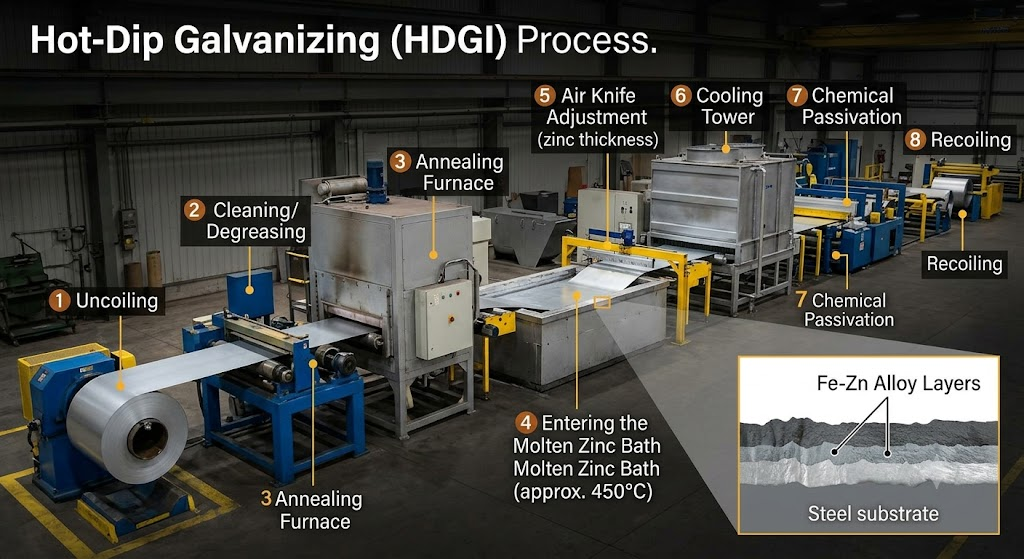
1. Hot-Dip Galvanizing Line (HDGI)
The Hot-Dip Galvanizing process is a continuous continuous-line method where cold-rolled steel coils are uncoiled, welded end-to-end, and fed into a series of processing zones.
- Pre-treatment & Cleaning: The steel strip first passes through a degreasing bath and rinsing spray to remove residual rolling oils, mill scale, and dirt. Next, it undergoes pickling (often using acid solutions) or thermal cleaning to ensure the surface is completely pristine.
- Annealing Furnace: The cleaned steel enters a reducing atmosphere annealing furnace. Here, the steel is heated to high temperatures to restore its ductility and mechanical properties after cold reduction, while simultaneously removing any remaining surface oxides.
- The Zinc Pot: The strip enters a continuous bath of molten zinc maintained at a precise temperature, usually between $445^\circ\text{C}$ and $460^\circ\text{C}$ ($833^\circ\text{F}$ to $860^\circ\text{F}$). As the steel moves through the pot, a metallurgical reaction occurs, forming a series of zinc-iron alloy layers topped with a layer of pure zinc.
- Air Knives (Coating Control): As the steel emerges vertically from the zinc pot, high-pressure air or nitrogen is blown onto both sides of the strip via specialized “air knives.” This precisely regulates and smooths out the thickness of the liquid zinc before it solidifies.
- Cooling and Post-Treatment: The strip is cooled rapidly via air-cooling towers and water quenching. It then passes through post-treatment sections like chemical passivation, skin-passing (for surface smoothing), and tension leveling before being recoiled.
2. Electro-Galvanizing Line (EG)
Unlike the thermal submersion method of HDGI, Electro-Galvanizing relies on electroplating principles.
- Process Dynamics: The steel strip is immersed in an aqueous solution of zinc salts (such as zinc sulfate or zinc chloride). An electrical current is passed through the solution via a zinc anode and the steel strip acting as the cathode. Positively charged zinc ions are attracted to the steel surface, creating a highly uniform, atomic-level deposition of pure zinc.
- Key Distinctions: Because it is a cold process, electro-galvanization does not alter the mechanical properties or temper of the base steel sheet. It yields a much thinner zinc layer than HDGI but offers unmatched surface uniformity and smoothness, free of any thermal spangles.
Section 3: Classification of Surface Finishes (Spangles Explained)
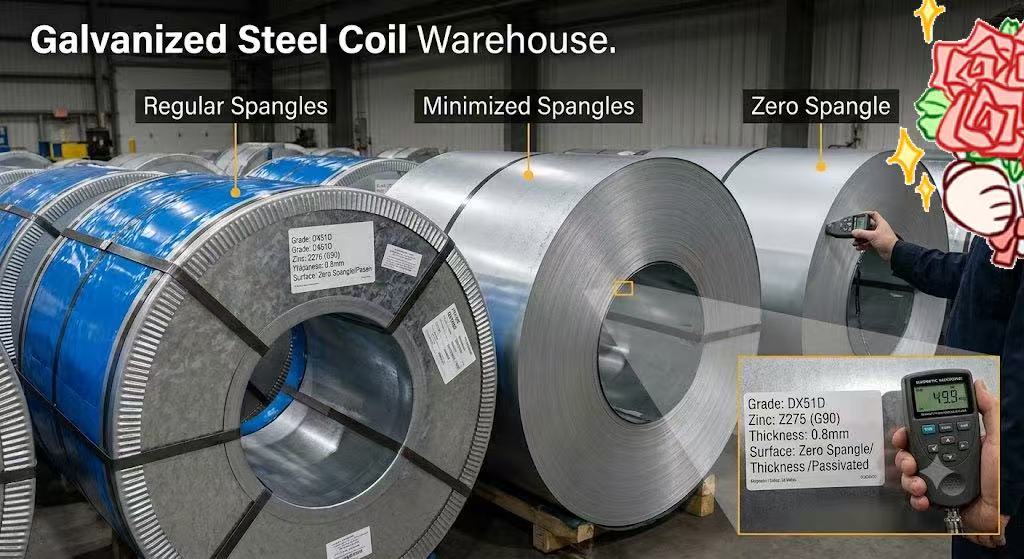
When looking at a hot-dip galvanized steel surface, you will often notice crystalline, flower-like patterns. These are called spangles. They are formed during the cooling phase as the molten zinc crystals grow outward from nucleation sites on the steel substrate.
Understanding spangle types is crucial for aesthetic and structural reasons:
Regular Spangles (Normal Spangles)
Historically, this was the classic look of galvanized steel. It features distinct, visible zinc crystal flakes. Regular spangles are achieved when traditional lead or antimony is added to the zinc bath to control crystal growth. While visually appealing to some, the uneven surface can create telegraphing patterns if the metal is subsequently painted.
Minimized Spangles
By applying specialized cooling techniques (such as blowing fine water mist or zinc powder onto the wet strip) or utilizing a high-purity zinc bath, manufacturers can force the zinc crystals to solidify rapidly. This results in much smaller, less visible spangles, providing a more uniform surface suitable for general applications and light coating.
Zero Spangles (No-Spangle / Smooth Finish)
With the modern push for environmental safety (eliminating lead from production lines), zero-spangle galvanized steel has become the global industry standard. The molten zinc bath consists of ultra-pure zinc (typically $>99.99\%$). The resulting finish is completely matte, uniform, and exceptionally smooth. Zero spangle is mandatory if you plan to post-paint or powder-coat the galvanized steel, as any underlying spangle texture will ruin the aesthetic quality of the paint finish.
Section 4: Understanding Galvanized Steel Coils Grades and Global Standards
One of the biggest pain points for procurement agents is translating steel grades across different international standardization systems. A mistake in grade selection can result in buying steel that cracks when bent, or steel that is far too stiff for the intended roll-forming machinery.
Below is a comprehensive comparative guide of the three primary global standards: European [ASTM A653] [EN 10346] or JIS G3302.
1. Commercial / Drawing Grades (For Forming and Bending)
These grades are designed for parts that undergo bending, profiling, deep drawing, and general fabrication.
- EN 10346 Standard: *
DX51D: Commercial quality (general use, simple bending, and roll-forming).DX52D: Drawing quality (better ductility for shallow drawing).DX53D: Deep drawing quality (highly ductile for complex pressed parts).DX54D: Special deep drawing quality.
- ASTM A653 Standard:
CS Type A, B, C: Commercial Steel (equivalent to DX51D).FS: Forming Steel.DDS: Deep Drawing Steel.
- JIS G3302 Standard:
SGCC: Commercial quality (widely used in Asia and global trade).SGCD1, SGCD2: Drawing and deep drawing qualities.
2. Structural Steel Grades (For Load-Bearing Applications)
When the galvanized coil is intended for roofing purlins, solar racking structures, or structural columns, you must specify a structural grade with guaranteed yield and tensile strength.
- EN 10346:
S250GD,S280GD,S350GD,S550GD. The number represents the minimum yield strength in Megapascals ($MPa$ or $N/mm^2$). For instance,S350GDguarantees a yield strength of at least $350\text{ MPa}$. - ASTM A653:
SS Grade 33,SS Grade 40,SS Grade 50 Class 1,SS Grade 80. The number correlates to the minimum yield strength in kilopounds per square inch ($ksi$). - JIS G3302:
SGC340,SGC400,SGC440,SGC570.
Section 5: Technical Parameters and Calculations for Buyers
To properly communicate with a manufacturer or trading house, you must master the core technical parameters of galvanized steel coils.
1. Dimension and Tolerance
- Thickness Range: Typically spans from $0.12\text{ mm}$ to $4.0\text{ mm}$. Thin gauges ($0.12\text{ mm} – 0.4\text{ mm}$) are heavily imported by developing nations for inexpensive corrugated roofing. Medium and heavy gauges ($0.5\text{ mm} – 4.0\text{ mm}$) are utilized in automotive and structural framing.
- Width Range: Usually ranges from $600\text{ mm}$ to $1500\text{ mm}$. The most common standard market widths are $1000\text{ mm}$, $1219\text{ mm}$ (4 feet), and $1250\text{ mm}$.
2. Zinc Coating Weight Calculation
The zinc coating weight indicates the amount of zinc applied to both sides of the steel sheet, measured in grams per square meter ($g/m^2$).
In the ASTM system, this is expressed as ounces per square foot ($oz/ft^2$), such as G60 or G90.
- G60 equals approximately $180\text{ g/m^2}$ total on both sides.
- G90 equals approximately $275\text{ g/m^2}$ total on both sides.
Quick Reference Table for Coating Lifetime Expectancy:
| Coating Designation | Zinc Mass (Both Sides Total) | Average Thickness Per Side | Common Environment Lifespan (C3 Rural) |
| Z40 / G15 | 40\text{ g/m^2} | ≈3.0 μm | Indoor use / extremely dry areas only |
| Z100 / G30 | 100\text{ g/m^2} | ≈7.0 μm | 5 – 10 years |
| Z140 / G45 | 140\text{ g/m^2} | ≈10.0 μm | 10 – 15 years |
| Z275 / G90 | 275\text{ g/m^2} | ≈20.0 μm | $20 – 30+$ years (Heavy Industrial / Outdoor) |
3. Theoretical Weight Calculation Formula for Galvanized Steel Coils
When auditing packing lists or calculating shipping logistics, you can calculate the theoretical weight of a galvanized steel sheet or coil using this industry-standard formula:
Weight (kg) = Thickness (mm) *Width (m) *Length (m)*7.85 + Zinc Coating Weight (kg/m)
Section 6: Surface Treatments and Post-Processing
Freshly produced galvanized steel coils are highly reactive when exposed to air and moisture without proper airflow. If coils are tightly wound or stacked flat in a humid cargo hold, moisture will get trapped, leading to a chemical reaction that forms zinc hydroxide—a powdery defect called white rust (storage stain). To prevent this, mills apply specific surface treatments.
Chromate Passivation (Cr6+ vs. Cr3+)
Passivation involves applying a thin chemical layer over the zinc coating.
- Hexavalent Chromium (Cr6+): Historically the most effective and cheapest passivation layer, offering incredible corrosion resistance. However, due to its toxic and carcinogenic nature, it is heavily restricted or banned in many regions (such as the European Union under RoHS regulations).
- Trivalent Chromium (Cr3+ / Eco-Friendly): The modern alternative. It complies with strict environmental standards while maintaining an excellent defensive layer against premature oxidation.
Oiling
Applying a thin layer of rust-preventative oil to the surface is common, especially when paired with passivation. The oil acts as a hydrophobic barrier. The oil layer must be washed off before any welding, painting, or forming operations at the end-user facility.
Anti-Fingerprint (AFP) Treatment
Commonly used on Electro-Galvanized (EG) coils destined for the home appliance market. A thin organic or inorganic composite film is applied over the zinc layer. It prevents greasy fingerprint smudges from showing during assembly lines and adds an extra layer of scratch resistance.
Section 7: Comprehensive Industrial Applications of Galvanized Steel Coils
The versatility of galvanized steel coils translates to an expansive presence across hundreds of industries. Let’s explore exactly how different sectors deploy this material.
1. Building and Construction
This sector consumes more than half of global galvanized steel coil production.
- Roofing and Cladding: Coils are fed directly into cold roll-forming machines to produce corrugated profiles, standing seam roof panels, and exterior wall sidings.
- Light Gauge Steel Framing: In residential and light commercial builds, galvanized steel profiles (studs, tracks, channels, and light steel keels) are replacing timber due to their resistance to termites, fire, and structural warping.
- Infrastructure Components: Highway guardrails, bridge decking, cable trays, utility poles, and agricultural fencing rely on high-coating GI steel to survive decades of harsh, outdoor exposure.
2. HVAC Systems (Heating, Ventilation, and Air Conditioning)
Ventilation ducts must remain hygienic, rust-free, and sturdy over decades inside ceilings. Galvanized sheets are ideal because they can be easily cut, bent, and locked into rigid round or rectangular duct profiles without the zinc peeling away at the seams.
3. Automotive Industry
While car bodies heavily leverage advanced alloyed materials and electro-galvanized components, hot-dip galvanized steel is critical for structural under-body parts, floor panels, reinforcement bars, and cross members where heavy moisture and road salt exposure demand elite galvanic protection.
4. Household and Consumer Appliances
The “white goods” sector (refrigerators, washing machines, dryers, air conditioners, and microwave ovens) requires precise dimensions and immaculate surfaces. Electro-galvanized coils with anti-fingerprint properties ensure these appliances retain their sleek look and structural integrity in humid environments like kitchens and bathrooms.
Section 8: Quality Control, Inspection Methods, and Defect Detection
When importing or purchasing bulk galvanized steel coils, relying strictly on the supplier’s word can be risky. Implementing a strict third-party inspection (such as SGS, BV, or Intertek) at the load port ensures your order matches the agreed-upon technical parameters.
1. Essential Quality Tests
- Coating Thickness Test (Magnetic Gauge / Weighing Method): Handheld digital coating thickness gauges use magnetic induction to instantly measure the exact thickness of the zinc layer in micrometers ($\mu\text{m}$). Alternatively, the precise laboratory method involves weighing a sample, stripping the zinc using acid, and re-weighing it to find the exact $g/m^2$ metric.
- T-Bend Test (Adhesion Check): A small sample strip is bent back on itself over varying radii ($0\text{T}$, $1\text{T}$, $2\text{T}$, etc.). The bent area is inspected under a magnifying glass. If the zinc layer cracks or flakes, it indicates poor adhesion, meaning the coil will likely fail during manufacturing.
- Salt Spray Test: Samples are placed inside a specialized chamber with a continuous fog of $5\%$ NaCl saltwater solution at a controlled temperature. This accelerates corrosion to simulate years of real-world exposure, mapping how many hours the coating can last before the appearance of red rust.
2. Common Defects to Watch For
Buyers must know how to spot substandard material during receiving inspections:
- White Rust: White, chalky patches on the surface caused by moisture entrapment. If it is light, it can be wiped off; if it is severe and dark pitting has occurred, the structural lifespan of the coating has been compromised.
- Flaking / Peeling Zinc: Caused by poor pre-treatment inside the annealing furnace or bad chemical balancing in the zinc pot. It renders the steel completely useless for stamping operations.
- Air Knife Scratches / Streaks: Vertical lines running along the length of the coil caused by blocked nozzles in the air knives, resulting in an uneven zinc distribution.
Section 9: Global Supply Chain Mechanics & Price Drivers
The global market price for galvanized steel coils is highly dynamic. fluctuating based on macroeconomic factors, raw material supplies, and geopolitical dynamics. Understanding these variables allows procurement departments to time the market effectively.
1. Raw Material Interdependence
The cost of a GI coil is intrinsically linked to two primary commodity markets:
- The Steel Substrate: Driven by the prices of iron ore, coking coal, scrap metal, and energy inputs needed to run blast furnaces or electric arc furnaces.
- The LME Zinc Price: Zinc pricing on the [London Metal Exchange] fluctuates daily. based on global mine supply, smelter shutdowns (often caused by surging electricity costs), and industrial demand. A major spike in zinc prices will immediately cause steel mills to levy surcharges on heavy-coating items like Z275.
2. Freight, Logistics, and Protective Seaworthy Packaging
Because coils weigh anywhere from $3$ to $12$ metric tons each, ocean freight is a massive cost component. Furthermore, because steel is highly susceptible to humidity during long sea voyages, cutting corners on packaging is a critical mistake.
Elements of a True Seaworthy Packing (Export Standard):
- Inner Wrap: Anti-rust waterproof paper paired with a tough plastic protective film wrap.
- Protective Shields: Inner and outer protective steel edge protector rings to prevent forklift or crane strap damage.
- Outer Core Shell: Heavy galvanized iron sheets enveloping the entire outer circumference and inner core hole.
- Strapping: Minimum of 4 radial straps and 3 circumferential high-tensile steel straps to lock the assembly securely together.
Section 10: Frequently Asked Questions (FAQ)
Q1: What is the difference between Galvanized (GI) and Galvalume (GL) steel coils?
A: The primary difference lies in the coating composition. While Galvanized steel uses a $100\%$ pure zinc coating, Galvalume steel is coated with an alloy composed of approximately $55\%$ aluminum, $43.4\%$ zinc, and $1.6\%$ silicon. Galvalume offers superior heat and corrosion resistance in flat environments, but Galvanized steel provides better sacrificial protection on cut edges and holds up much better in alkaline/agricultural environments.
Q2: Can galvanized steel coils be welded?
A: Yes, but it requires specialized safety procedures. Welding galvanized steel causes the zinc coating to vaporize, producing highly toxic zinc oxide fumes (which can cause “metal fume fever”). The zinc coating should ideally be ground away from the weld zone before joining, and the workspace must be thoroughly ventilated. Post-weld, the joint must be treated with a zinc-rich cold-galvanizing spray to restore corrosion protection.
Q3: How long will a Z275 galvanized steel coil last outdoors?
A: In a standard rural or mild urban environment (C2/C3 classification), a Z275 coating can easily last between $20\text{ to }30\text{ years}$ before the first signs of base steel rust appear. However, in highly polluted industrial zones or marine locations right along the coastline, the lifespan can drop significantly due to accelerated chemical breakdown by sulfur dioxides or chlorides.
Q4: Why is my galvanized steel turning black or gray?
A: This is usually a sign of natural weathering. Over time, zinc reacts with atmospheric oxygen to form zinc oxide, which then reacts with moisture to form zinc hydroxide, and finally with carbon dioxide to form zinc carbonate ($ZnCO_3$). This final layer, known as the zinc patina, is highly stable, tightly adherent, and dull gray or charcoal in appearance. It acts as an excellent shield, slowing down further corrosion.
Q5: Where can I buy wholesale galvanized steel coils?
A: When sourcing wholesale galvanized steel coils, it is recommended to work directly with certified steel mills or verified Tier-1 exporters who can provide standard mill test certificates for every batch of galvanized steel coils.
Conclusion
Galvanized steel coils represent the perfect marriage of structural utility and chemical protection. For any manufacturing, engineering, or procurement project, a deep, comprehensive mastery of GI coil types, international standards, surface options, and coating configurations is non-negotiable.
By prioritizing correct technical specifications, working with audited manufacturers that provide verifiable Mill Test Certificates, and insisting on robust export seaworthy packaging, you can protect your investments, ensure outstanding product performance, and minimize overhead costs over the long term.
Quick Summary for Galvanized Steel Coils Buyers
Before placing your order for galvanized steel coils, make sure to confirm the following checkpoints with your manufacturer:
Steel Grade: Ensure the galvanized steel coils grade matches your forming needs (e.g., DX51D or SGCC).
Zinc Mass: Specify if you need heavy-duty galvanized steel coils (like Z275/G90) or standard light-coated ones.
Surface Finish: Choose zero-spangle galvanized steel coils if post-painting is required.
Packaging: Demand seaworthy export packaging to fully protect your galvanized steel coils from white rust during transit.
Have specific size or zinc coating requirements for your project? [Contact Our Steel Experts] today to get a free quote.
If you need a quick quote, please feel free to [Contact Our Sourcing Experts].
Our professional sales team will reply within 24 working hours and offer full technical parameter support for your whole project.
Email: jenny@sbtgi.com
WhatsApp: +86 13905436749
Official Website: www.sbtgi.com