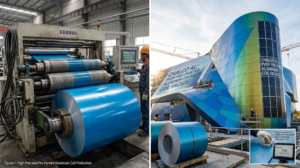
In modern architectural design and industrial manufacturing, the choice of materials often determines the success or failure of a project. With the comprehensive popularization of green building concepts in 2026, a metal material that combines both aesthetics and environmental protection has stood out. This is the pre-painted aluminum coil that frequently appears in major high-end projects. As a composite material undergoing high-precision coating treatment on the surface of aluminum coils, it is leading a new round of material revolution. Whether on the metal curtain walls of skyscrapers or in the lightweight components of new energy vehicles, its presence is everywhere.
According to the latest global non-ferrous metals industry research report, the market demand for high-performance surface-treated aluminum is growing at an alarming rate. In the data released by the International Aluminium Institute (International Aluminium Institute), lightweighting and high recycling rates have become key indicators for measuring core materials of the future. This metal coil, which has undergone precise roll coating processes, perfectly aligns with this era’s trend. To learn more about our company’s manufacturing capability, you can check our about us page. This article will take you deep into the core advantages of this material and reveal why it has become an irreplaceable industry mainstream today.
1. What is a High-Performance Pre-painted Aluminum Coil?
1. Structure and Manufacturing Process Analysis
As the name suggests, it refers to an aluminum metal coil whose surface has undergone color coating treatment. During the manufacturing process, high-quality aluminum alloy substrates must first undergo strict surface cleaning and chemical pre-treatment. Chemical pre-treatment typically includes degreasing, water washing, and passivation treatment, aiming to form a dense conversion film on the aluminum surface. This conversion film not only enhances the corrosion resistance of the substrate but also significantly improves the adhesion of subsequent coatings.
Subsequently, the substrate enters an automated, high-speed roll coating production line to undergo single-layer or multi-layer coating application in a sealed, dust-free environment. Finally, after high-temperature baking and curing, the coating bonds tightly with the aluminum alloy substrate, forming a highly protective composite surface layer. This precise processing flow ensures that the final factory products possess extremely high color uniformity and adhesion.
2. Substrates and Mainstream Coating Classifications
Depending on different application environments, the substrate usually selects different grades of aluminum alloys such as the 1000 series, 3000 series, or 5000 series. For instance, the 3003 alloy, with added manganese, provides excellent rust resistance, making it the preferred choice for roofing. The 5052 alloy contains more magnesium, offering higher strength suitable for coastal environments with high wind pressure. The key to determining its surface protection performance lies in the type of coating selected. pre-painted aluminum coil Currently, the most mainstream coatings on the market include the following three:
- Polyester Coating (PE): Possesses good adhesion and rich colors, mostly used for interior decoration and medium- to short-term temporary constructions.
- Fluorocarbon Coating (PVDF): Contains an extremely strong carbon-fluorine bond molecular structure, providing excellent UV resistance and super weatherability.
- Polyurethane Coating (PU): Features outstanding wear resistance and scratch resistance, often used in fields with high requirements for surface mechanical strength.
2. 5 Core Reasons Why the Construction and Industrial Sectors Favor It
Reason 1: Unparalleled Weatherability and Corrosion Resistance
In the practical application of traditional metal building materials, rust and chemical corrosion have always been a pain point difficult to resolve completely. Ordinary steel plates are highly prone to oxidation reactions and structural damage in humid environments or coastal areas with acid and alkali salt spray. However, high-quality aluminum coil substrates themselves possess natural oxidation resistance; even if the surface is scratched, it can quickly form a dense protective film.
Together with modern technology-developed fluorocarbon coatings, the pre-painted aluminum coil can confidently resist extreme UV radiation and acid rain erosion. The polyvinylidene fluoride resin content in PVDF coatings is typically above 70%, making its chemical bonds extremely difficult to break by UV light. Even today, with global warming and frequent extreme weather events, it guarantees that the surface will not fade or crack for more than 20 years.
Reason 2: Perfect Balance Between Processability and Structural Rigidity
Many people often mistakenly believe that metal materials with high toughness will lack hardness and rigidity. However, through reasonable alloy composition adjustment, such as adding a small amount of manganese or magnesium elements into the aluminum substrate, its yield strength can be significantly improved. This material not only possesses excellent wind pressure resistance but also boasts amazing flexibility and elongation rates.
In subsequent deep processing in factories or bending at construction sites, the coating of the pre-painted aluminum coil will not show any micro-cracking or peeling due to metal deformation. This allows designers to boldly attempt various exaggerated streamlined curved surfaces, irregular structures, or deep stamping shapes. Whether it is meeting the strict 0T-2T requirements in T-bend tests or undergoing complex continuous roll forming, it handles it with ease.
Reason 3: Green, Low-Carbon, and 100% Recyclable Environmental Attributes
Under the current global background of vigorously promoting carbon neutrality, the carbon footprint of building materials has received unprecedented attention. According to the definitions of green building standards found in encyclopedias like Baidu Baike (Baidu Baike – Green Building Standards), green building materials must meet environmental protection requirements throughout their life cycle. A unique advantage of aluminum metal lies in its lossless recyclability, and the energy consumption of recycled aluminum smelting is only about 5% of primary aluminum production.
Choosing pre-painted aluminum coil not only recovers most of the material value after a building is demolished but also significantly reduces the invisible carbon emissions in the early stages of a project. Moreover, the modern roll coating process used on its surface is an environmentally friendly production method, and the emission of harmful VOCs is strictly controlled. This helps the material win valuable points when applying for LEED green building certification.
Reason 4: Structural Safety Advantages Brought by Lightweighting
Applying this lightweight metal to high-rise building curtain walls or roofing systems can bring immediate weight reduction effects. Under the premise of the same thickness, the density of aluminum is only 2.71 $g/cm^3$, which is about one-third that of iron. This means that using a pre-painted aluminum coil as an exterior wall decoration panel can reduce the self-weight of the entire building main structure by dozens or even hundreds of tons.
The reduction in self-weight not only means a significant reduction in material investment costs for the bottom foundation and load-bearing steel structures. More importantly, when facing sudden natural disasters such as earthquakes and strong typhoons, a lighter exterior wall structure can substantially reduce the overall inertial destructive force. This improves the seismic safety rating of high-rise buildings and secures the safety of urban public spaces.
Reason 5: Large Color Span and Highly Textured Appearance Expressiveness
Modern architecture not only requires durability but also pursues visual aesthetics to an unprecedented height. Through advanced precision coating equipment, the pre-painted aluminum coil can perfectly simulate almost any color within human imagination. In addition to common solid color series, high-gloss, and matte textures, it can also easily achieve highly simulated wood grain, stone grain, and brushed metal effects.
For instance, chameleon coating technology allows the panels to present flowing gradient colors under different lighting angles. This rich choice of colors and textures gives urban architectural designers infinite creative space. It sheds the cold, stereotypical impression of traditional metals, allowing various modern landmark buildings to present a vibrant sense of a modern metropolis.
3. Mainstream Application Scenarios: From Roof Curtain Walls to Home Appliance Liners
1. Modern Architectural Metal Curtain Walls and Roofing Systems
In the construction of modern high-rise buildings, large international airports, high-speed railway stations, and other transportation hubs, it is an absolute star material. Its ultra-high flatness and wind pressure resistance make it very suitable for processing into large-specification aluminum single panels or aluminum honeycomb panels. Not only that, in standing seam roofing systems, the excellent bending performance of the pre-painted aluminum coil ensures absolute airtightness and watertightness at the interlocking parts, providing long-lasting protection in typhoon-prone coastal areas.
2. Transportation and Automotive Lightweight Components
With the explosive growth of global new energy vehicle penetration, vehicle weight control has become the core R&D direction for major car companies. In addition to breakthroughs in battery technology, car bodies, doors, van boxes, and metro light rail interior panels are also accelerating the realization of “replacing steel with aluminum.”Using the pre-painted aluminum coil not only saves car companies from subsequent tedious overall painting processes. improving production line efficiency, but also significantly improves the shock resistance and corrosion-resistant life of components. In the field of logistics vehicles, a lighter body directly translates to a longer driving range.
3. High-End Home Appliance Panels and Liners
he refrigerator side panels, air conditioner outdoor unit casings, and microwave oven liners that are ubiquitous in our daily lives also widely use pre-painted aluminum coil. The home appliance industry has extremely strict, almost picky standards for surface flatness, gloss, and fingerprint resistance.
Through customized pre-coating processes, the surface of the aluminum coil can be attached with a special functional coating layer that is antibacterial, oil-resistant, and high-temperature resistant. This significantly simplifies the stamping and assembly processes for appliance manufacturers while elevating the premium feel of the end products. For more detailed product options, please visit our featured product catalog page.
4. SEO Long-Tail Keyword Expansion: How to Accurately Select Quality Suppliers?
In the actual procurement process, facing a dazzling array of products on the market, customers often fall into choice anxiety. To buy products that are truly value-for-money and meet engineering standards, one must learn to screen from a professional perspective. The following three high-frequency long-tail search terms are precisely the most core focuses for many senior purchasers when looking for partners:
1. PVDF Pre-painted Aluminum Coil Factory Direct Sale
Finding source manufacturers with R&D and mass production capabilities who offer direct sales is the most effective way to reduce procurement costs. Direct manufacturers not only save a lot of middleman price differences but can also provide one-on-one customization of alloy grades and coating thicknesses according to project drawings. When inspecting a manufacturer, key attention should be paid to whether they are equipped with multi-color precision high-speed roll coating production lines imported from Germany or Japan. Advanced equipment can control coating thickness errors to within $\pm 1$ micron, ensuring zero color variation across large batches.
2. Weatherproof Color Coated Aluminum Coil Specification Parameters
Engineering projects in different regions have vastly different requirements for material specification parameters. For example, curtain wall projects in tropical and rainy areas usually require that the fluorocarbon (PVDF) coating thickness must reach more than 25 microns. Indicators that need to be carefully confirmed during procurement include: substrate alloy grade (such as 3003-H24), aluminum plate thickness (typically between 0.2mm and 3.0mm), coating type, and glossiness. Understanding these parameters helps project engineers prevent hidden hazards caused by improper material matching early in the design stage.
3. Pre-coated Aluminum Coil for Ceiling Price Trend
Indoor integrated ceilings and aluminum gusset plates usually select highly cost-effective polyester (PE) coatings due to their relatively mild usage environment. The core factor affecting its price fluctuations is mainly the real-time trend of spot aluminum ingot prices on the Yangtze River international market. Since processing fees remain relatively stable, mastering the raw material price cycles is crucial for timing bulk purchases. High-quality suppliers usually establish a sound metal futures hedging mechanism, thereby providing downstream customers with relatively stable long-term supply prices and reducing market volatility risks.
5. 3 Practical Tips for Purchasing and Quality Inspection
To distinguish truly high-quality pre-painted aluminum coil in a mixed market, mastering some basic testing methods is crucial. During product receipt and inspection, project quality control personnel can make preliminary determinations through the following three simple and efficient means:
- Visual Surface Defect Method: Under sufficient light (D65 standard light source recommended), carefully observe whether there are color differences, particles, bubbles, orange peel, or obvious missing coating phenomena on the surface of the coil.
- Cross-Hatch Test for Adhesion: Use a professional cross-hatch cutter to cut a 1mm*1mm matrix grid on the coating surface, ensuring the cut reaches the aluminum substrate. Apply standard test tape, pull it off sharply at a 180° angle, and observe whether the coating peels off. Reaching Class 0 or Class 1 is usually qualified.
- Wiping Method to Check Curing Degree: Use a cotton ball soaked in MEK (methyl ethyl ketone) solvent, apply a pressure of about 1kg to wipe back and forth on the surface (usually requiring more than 100 times). Detect whether the coating dissolves, reveals the substrate, or fades seriously to judge whether the baking and curing are complete.
6. Global Market and Future Technology Outlook
As the global supply chain shifts toward a lower carbon footprint, this material is undergoing profound technical iterations. On one hand, bio-based coatings are gradually replacing traditional petroleum-based chemical coatings, further reducing the carbon emissions of the coating itself. On one hand, the premium pre-painted aluminum coil serves as the perfect foundation for these innovations. On the other hand, developing functional specialty coatings for the pre-painted aluminum coil is becoming the industry’s new race track.
For instance, hydrophilic self-cleaning coatings can use rainwater to automatically wash away surface dust, dramatically reducing the long-term maintenance costs of high-rise building curtain walls. At the same time, high-reflectance cool roof coating technology can reflect more than 70% of solar heat radiation, significantly lowering building air conditioning energy consumption during summer.
With the integration of digital supply chains and smart manufacturing, future production will achieve a higher degree of flexible customization. This means that even small-batch, personalized orders can be completed on fully automated production lines with high efficiency and low cost. Whether in traditional building envelope systems or imaginative future smart hardware, its application boundaries are bound to expand like never before.
7. Conclusion
In summary, pre-painted aluminum coil, with its all-around advantages in weatherability, processability, environmental friendliness, lightweighting, and aesthetic expressiveness, has firmly occupied the core ecological niche of modern industrial materials. It is not just a durable industrial product but a crucial catalyst driving cities toward greener, safer, and more sustainable directions. Choosing this material means embracing a lightweight, high-aesthetic, and sustainable future.
Contact Us for Premium Pre-painted Aluminum Coil Solutions:
WhatsApp: +86 139 0543 6749 (Click to chat)
Email: jenny@sbtgi.com
Website: www.sbtgi.com