When sourcing galvanized steel for automotive panels, appliance housings, or painted applications, the surface finish of the zinc coating matters more than most buyers realize. Among the three main spangle types — zero spangle, normal spangle, and regular (large) spangle — the zero spangle galvanized coil has become the preferred choice for projects demanding a smooth, uniform surface. But what exactly is a zero spangle galvanized coil, and how do you choose the right one?
This guide walks you through everything you need to know: from how zero spangle forms during the hot-dip galvanizing process, to a practical 7-step framework for selecting the correct zero spangle galvanized coil for your specific application. Whether you are a procurement manager, project engineer, or quality inspector, these steps will help you avoid costly specification mistakes.
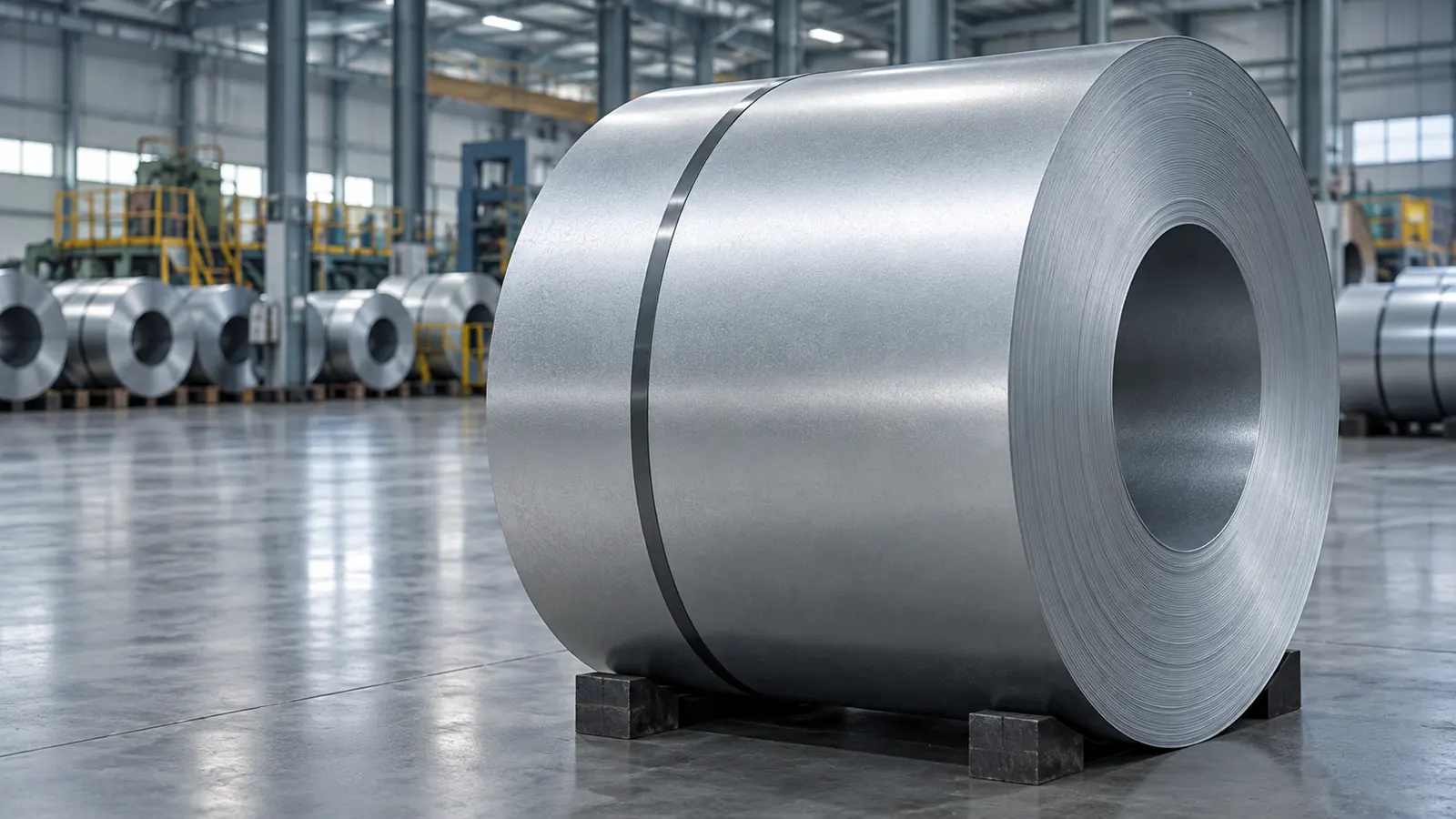
What Is a Zero Spangle Galvanized Coil?
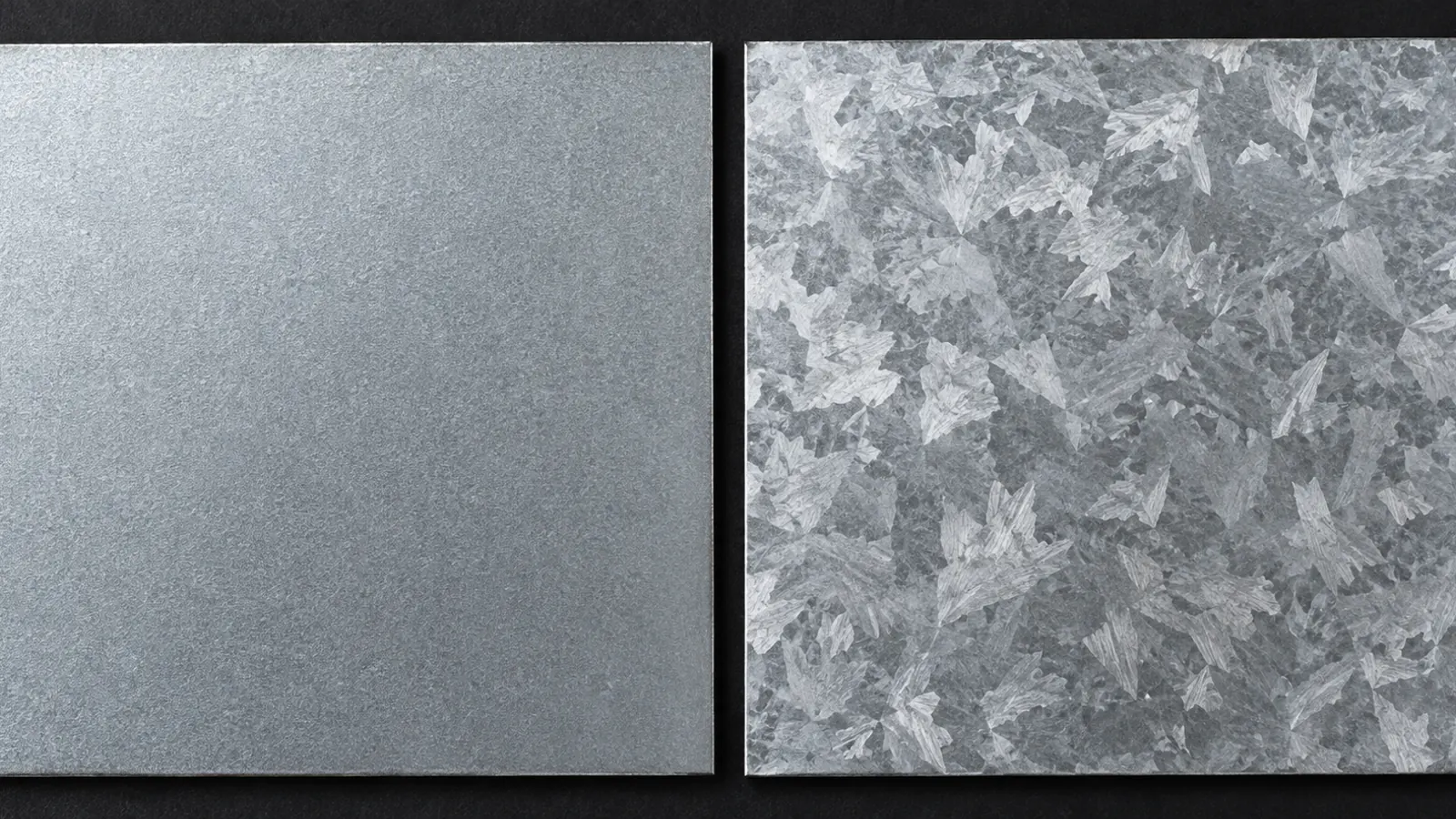
A zero spangle galvanized coil is a hot-dip galvanized steel coil whose zinc coating surface shows no visible crystalline flower-like pattern — the “spangle.” In traditional galvanized steel, the spangle appears as a dendritic, snowflake-like crystal structure formed as molten zinc solidifies on the steel strip. A zero spangle galvanized coil eliminates this pattern entirely, producing a remarkably smooth, matte-gray surface.
According to the hot-dip galvanizing process overview on Wikipedia, the zinc coating forms a metallurgical bond with the steel substrate through a series of iron-zinc alloy layers. In a zero spangle galvanized coil, the surface zinc layer solidifies without forming visible dendritic crystals, resulting in the smooth finish that distinguishes it from regular spangle material.
Key characteristics of a zero spangle galvanized coil include:
- Smooth, uniform surface: No visible crystal pattern, ideal for painting or coating
- Matte gray appearance: Cleaner aesthetic compared to the shiny, flaked surface of regular spangle
- Consistent surface roughness: Lower and more uniform Ra values across the entire coil width
- Excellent paint adhesion: The smooth surface provides an optimal substrate for liquid paint or powder coating
- Reduced surface defects: Fewer raised crystal boundaries mean fewer sites for coating failure or corrosion initiation
How Zero Spangle Forms During Galvanizing
The formation of a zero spangle galvanized coil depends on controlled cooling and precise zinc bath chemistry. In the standard hot-dip galvanizing line, steel strip passes through a molten zinc bath at approximately 450°C (842°F). The spangle pattern — or its absence — is determined by what happens in the seconds after the strip exits the zinc pot.
Three main factors control whether the result is a zero spangle galvanized coil:
1. Zinc Bath Composition
In traditional galvanizing, lead is added to the zinc bath to promote spangle formation. Lead lowers the surface tension of molten zinc and encourages dendritic crystal growth during solidification. To produce a zero spangle galvanized coil, lead content is minimized or replaced. Modern lines use lead-free zinc baths with controlled aluminum content (typically 0.15–0.30%) to suppress crystal pattern formation.
2. Cooling Rate Control
The steel strip is cooled rapidly and uniformly using air knives and controlled gas wiping immediately after exiting the zinc bath. This rapid cooling prevents the slow, directional solidification that creates visible spangle crystals. The cooling rate for a zero spangle galvanized coil is typically maintained above 30°C/second in the critical temperature zone just below the zinc solidification point.
3. Spangle Suppression Technology
Some galvanizing lines apply additional techniques to ensure a true zero spangle galvanized coil surface:
- Mist cooling: Fine water mist applied to the zinc surface disrupts crystal nucleation
- Roll skin-pass: A light cold-rolling pass (skin pass) after galvanizing mechanically flattens any residual spangle pattern
- Chemical treatment: Selective surface alloying elements that refine grain structure during solidification
Zero Spangle vs. Normal Spangle vs. Regular Spangle: Comparison
Understanding the differences between the three spangle types is critical when deciding whether a zero spangle galvanized coil is the right choice for your project. The table below summarizes the key differences:
| Property | Zero Spangle Galvanized Coil | Normal Spangle | Regular (Large) Spangle |
|---|---|---|---|
| Surface Appearance | Smooth, matte gray, no visible crystals | Small visible crystal pattern, moderate shine | Large, distinct flower-like crystals, bright |
| Surface Roughness (Ra) | 0.4–1.0 µm (low, uniform) | 0.8–1.5 µm (moderate) | 1.2–2.5 µm (high, variable) |
| Zinc Bath Lead Content | Lead-free or trace (<0.003%) | Low lead (0.03–0.10%) | Higher lead (0.10–0.20%) |
| Paint Adhesion | Excellent — ideal for painting | Good | Fair — may show telegraphing through paint |
| Typical Applications | Automotive panels, appliance housings, painted profiles, HVAC ducts | Construction panels, roofing, general fabrication | Structural steel, outdoor fencing, industrial uses |
| Coating Designation Range | Z100 – Z275 (per ASTM A653) | Z100 – Z275 | Z120 – Z350 |
| Relative Cost | Higher (lead-free process + skin pass) | Standard | Lower (traditional process) |
As the comparison shows, a zero spangle galvanized coil commands a price premium but delivers superior surface quality, making it the clear choice for applications where appearance and coating performance matter.
Does Zero Spangle Finish Affect Corrosion Resistance?
A common misconception is that the smooth surface of a zero spangle galvanized coil offers less corrosion protection than a regular spangle finish. In reality, corrosion resistance depends primarily on the zinc coating weight (mass), not the spangle pattern.
The zinc coating on a zero spangle galvanized coil provides sacrificial (cathodic) protection to the underlying steel through the same electrochemical mechanism described by the American Galvanizers Association. A zero spangle galvanized coil with a Z275 coating designation (275 g/m² total both sides) provides the same theoretical corrosion life as a regular spangle coil with the same Z275 coating weight.
However, there are secondary corrosion advantages to a zero spangle galvanized coil:
- Fewer surface defects: The absence of raised crystal boundaries means fewer sites where moisture and contaminants can accumulate
- Better paint performance: When painted, the smooth surface of a zero spangle galvanized coil reduces under-film corrosion and blistering
- More uniform coating thickness: Without crystal growth variations, the zinc layer distributes more evenly across the strip width
In short: choosing a zero spangle galvanized coil does not sacrifice corrosion resistance — it may actually improve long-term performance in painted or coated applications.
7 Steps to Choose the Right Zero Spangle Galvanized Coil
Follow these seven steps to ensure you specify and source the correct zero spangle galvanized coil for your project requirements.
Step 1: Check for Smooth Surface and Visual Quality
The defining feature of a zero spangle galvanized coil is its smooth, spangle-free surface. When you receive samples or inspect production coils, perform a visual inspection under good lighting at multiple angles. A genuine zero spangle galvanized coil should show no visible crystalline pattern across the entire width. Look for:
- Uniform matte gray color from edge to edge
- No shiny, reflective crystal facets
- No dendritic “snowflake” or “starburst” patterns
- Consistent surface texture when viewed at low angle lighting
If you see any visible spangle pattern, the coil may be a “minimized spangle” rather than a true zero spangle galvanized coil. This distinction matters for paint-grade applications.
Step 2: Verify Thickness Tolerance and Dimensional Accuracy
Dimensional accuracy is critical for any galvanized coil, but especially for a zero spangle galvanized coil used in precision forming or stamping operations. Verify:
- Base steel thickness: Measure at multiple points across the width and length. Per ASTM A653/A653M, standard thickness tolerances vary by grade and width
- Coil width: Confirm slit width tolerance (typically ±1.0 mm for mill-edge, ±0.5 mm for trimmed edges)
- Coating thickness uniformity: Use a magnetic gauge to measure zinc coating at edge, quarter, and center positions. A quality zero spangle galvanized coil should show less than 10% variation across the width
- Flatness: Check for edge wave, center buckle, or crossbow. Acceptable flatness for a zero spangle galvanized coil is typically ≤5 mm/m for standard grades
Request a dimensional inspection report from the supplier before committing to a bulk order of zero spangle galvanized coil.
Step 3: Assess Surface Finish, Roughness, and Texture
For painted applications, the surface roughness of your zero spangle galvanized coil directly affects paint adhesion and final finish quality. Use a surface roughness tester to measure Ra (arithmetic mean roughness) values:
- Ideal Ra range for painting: 0.6–1.2 µm for a zero spangle galvanized coil
- Too smooth (Ra < 0.4 µm): Paint may not anchor properly to the zinc surface
- Too rough (Ra > 1.5 µm): Paint may telegraph surface imperfections, requiring more primer
A properly produced zero spangle galvanized coil typically falls within the ideal range because the lead-free process and controlled cooling produce a consistently fine surface texture. If the supplier offers a skin-passed zero spangle galvanized coil, the roughness profile will be even more controlled.
Step 4: Match Coating Thickness to the Service Environment
The zinc coating weight on your zero spangle galvanized coil determines its corrosion life. Coating designations per ASTM A653 use a “Z” prefix followed by the total coating mass in g/m² (both sides combined). Select the right coating weight based on your service environment:
| Coating Designation | Approx. Zinc Thickness (per side) | Recommended Service Environment |
|---|---|---|
| Z100 | ~7 µm | Indoor, dry environments; appliance interiors |
| Z140 | ~10 µm | Indoor with humidity; automotive interior panels |
| Z180 | ~13 µm | Outdoor, mild urban; painted building panels |
| Z275 | ~20 µm | Outdoor, industrial/marine; structural and architectural |
| Z350 | ~25 µm | Harsh marine/industrial; long-life outdoor structures |
For most automotive and appliance applications, a Z120–Z180 zero spangle galvanized coil provides adequate protection. For outdoor painted panels or architectural uses, specify a Z275 zero spangle galvanized coil as a minimum.
Step 5: Check Formability for Complex Shaping
If your project involves deep drawing, bending, or roll-forming, the mechanical properties of the zero spangle galvanized coil are as important as the coating. The zinc coating on a zero spangle galvanized coil is relatively soft and ductile, but the underlying steel grade determines forming behavior.
Common ASTM A653 steel designations for formable zero spangle galvanized coil include:
- CS (Commercial Steel): Basic forming, simple bends
- FS (Forming Steel): Moderate drawing, roll-forming
- DDS (Deep Drawing Steel): Deep-drawn parts, complex shapes
- EDDS (Extra Deep Drawing Steel): Severe drawing, automotive exposed panels
When specifying a zero spangle galvanized coil for forming, request the mechanical property certificate showing yield strength, elongation, and r-value (plastic anisotropy ratio). For deep drawing applications, an EDDS zero spangle galvanized coil with elongation > 40% and r-value > 1.6 is recommended.
Step 6: Ensure Structural Strength and Hardness
For structural or load-bearing applications, the zero spangle galvanized coil must meet specific mechanical property requirements. Structural steel (SS) and high-strength low-alloy (HSLAS) designations under ASTM A653 cover a range of strength grades:
- SS Grade 33: Yield strength ≥ 230 MPa — general structural use
- SS Grade 40: Yield strength ≥ 275 MPa — medium-load structural
- SS Grade 50: Yield strength ≥ 340 MPa — heavy structural, building panels
- SS Grade 80: Yield strength ≥ 550 MPa — high-strength, load-critical
Verify that the zero spangle galvanized coil you select has both the correct strength grade and the required coating designation. A high-strength zero spangle galvanized coil with insufficient zinc coating will fail prematurely in corrosive environments, regardless of steel strength.
Step 7: Request Test Reports and Certification
Never accept a zero spangle galvanized coil without proper documentation. A complete Mill Test Certificate (MTC) per ASTM A924/A924M (general requirements for zinc-coated steel sheet) should include:
- Chemical composition of the base steel (heat analysis)
- Mechanical properties: Yield strength, tensile strength, elongation
- Coating weight results: Actual measured values vs. specified designation
- Surface finish declaration: Confirming zero spangle (lead-free process)
- Coating uniformity: Three-point or five-point test results across width
- Bend test results: Pass/fail at specified bend diameter
- Stand compliance: ASTM A653, JIS G3302, or EN 10346 as applicable
If the supplier cannot provide a full MTC for the zero spangle galvanized coil, treat it as a red flag. International buyers importing a zero spangle galvanized coil should also request third-party inspection (SGS, Bureau Veritas, or equivalent) before shipment.

Common Specification Mistakes When Ordering Zero Spangle Galvanized Coil
Even experienced buyers make errors when specifying it. Here are the most common mistakes and how to avoid them:
1. Confusing “minimized spangle” with “zero spangle”: Minimized spangle has a reduced but still visible crystal pattern. A true spangle-free product has no visible spangle at all. Always specify “zero spangle” or “spangle-free” in your purchase order.
2. Under-specifying coating weight: Choosing Z100 for an outdoor application because it costs less. This leads to premature red rust. Match the coating weight to the environment (see Step 4).
3. Ignoring surface roughness for paint applications: Not checking Ra values before painting. A coil with Ra outside the 0.6–1.2 µm range can cause paint adhesion failures.
4. Selecting wrong steel grade for forming: Using CS grade for a deep-draw application. Specify DDS or EDDS for the forming grade if forming complexity is high.
5. Neglecting edge condition: Not specifying trimmed vs. mill-edge. For painted parts, a trimmed-edge product prevents edge rust propagation.
6. Accepting material without MTC: No test report means no traceability. Always require a full Mill Test Certificate for every order.
What Should Buyers Consider When Importing Zero Spangle Galvanized Coil?
For international buyers — especially those importing it from China — additional due diligence is essential:
- Supplier qualification: Visit the galvanizing line or request a virtual audit. Confirm the line is capable of producing true spangle-free material (lead-free zinc pot, skin-pass capability, controlled cooling).
- Incoterms clarity: Specify FOB, CIF, or DDP clearly. Shipments under wrong Incoterms can result in unexpected port and customs charges.
- Standard alignment: Chinese mills may produce to GB/T 2518 (Chinese national standard for continuous hot-dip galvanized steel sheet). Confirm equivalence to ASTM A653 or EN 10346 for your order.
- Lead time buffer: Production may require schedule adjustments on shared galvanizing lines. Allow 20–30% extra lead time compared to regular spangle.
- Third-party inspection: Engage SGS, TÜV, or Bureau Veritas to inspect the coil before loading. Verify coating weight, surface finish, dimensions, and packaging.
- Packaging for sea freight: Ensure it is packed with desiccant, VCI paper, and sealed wrapping to prevent “white rust” (zinc hydroxide) during ocean transit.
Conclusion
Choosing the right zero spangle galvanized coil for your project requires attention to surface quality, dimensional accuracy, coating weight, formability, mechanical strength, and proper certification. By following the 7 steps outlined above, you can confidently specify material that meets your application requirements and avoids the common pitfalls that lead to costly rework or premature failure.
At Cybertron Metal, we supply zero spangle galvanized coil to ASTM A653, JIS G3302, and EN 10346 standards, with full Mill Test Certificates and lead-free process verification. Whether you need Z100 for appliance interiors or Z275 for architectural panels, our product is produced with controlled surface roughness and consistent coating uniformity.
Contact us to discuss your requirements, request samples, or obtain a quotation.
Get a Quote for Zero Spangle Galvanized Coil
If you are looking for a reliable supplier of spangle-free galvanized coil for painted components, appliance panels, ductwork, roll-formed profiles, or construction projects, we can help.
Contact Details: – Company: Shandong Cybertron Metal Technology Co., Ltd.
Contact Details:
– Company: Shandong Cybertron Metal Technology Co., Ltd.
– Email: jenny@sbtgi.com
– Website: www.sbtgi.com
– Phone: +86-13905436748
– WhatsApp: +86-13905436749
– Address: Shandong,China
Please contact us with your required thickness, width, coating mass, steel grade, quantity, and destination port. We will provide a clear and competitive quotation based on your actual project needs.